
Red Faber was one of the most remarkable pitchers of the early 20th century, known for his durability, mastery of the spitball, and key role in the success of the Chicago White Sox. A Hall of Famer whose career spanned from 1914 to 1933, Faber played an instrumental role in shaping the game during the Deadball Era and beyond. His contributions to the sport extended beyond his impressive statistics, as he was one of the last legal spitball pitchers in baseball history, a key figure in the 1917 World Series championship, and a pitcher who adapted to the changing nature of the game over nearly two decades in the majors. His legacy as a workhorse, a skilled tactician on the mound, and a player of immense integrity ensures his place among the greats of baseball history.
Urban Clarence “Red” Faber was born on September 6, 1888, in Cascade, Iowa, a small town that produced one of baseball’s most durable and effective pitchers. Growing up in rural Iowa, Faber was drawn to baseball at an early age. Like many children of his era, he played the game on local sandlots, developing his skills as both a pitcher and a hitter. His athleticism was not limited to baseball, as he also excelled in football and track during his youth. However, baseball was his true passion, and he quickly established himself as a talented pitcher in the amateur ranks.

Faber’s journey to professional baseball began when he enrolled at Saint Joseph’s College in Dubuque, Iowa. While there, he continued to hone his pitching abilities, impressing local scouts with his command and ability to outthink batters. His time at Saint Joseph’s was brief, as he soon left school to pursue a career in professional baseball. In 1909, he signed with Dubuque in the Illinois-Indiana-Iowa League, marking the beginning of his ascent through the minor leagues.
His early years in professional baseball were a testament to his determination and adaptability. Faber quickly established himself as one of the best pitchers in the minors, catching the attention of Major League scouts. In 1911, the Chicago White Sox purchased his contract, believing they had found a future ace. Faber spent the next few years refining his skills in the minor leagues, most notably developing a mastery of the spitball, a pitch that would define his career. At the time, the spitball was a legal and widely used pitch that involved applying saliva or another substance to the ball to create unpredictable movement. Faber’s ability to control the spitball and use it effectively made him one of the most difficult pitchers to hit.
Faber made his Major League debut with the White Sox in 1914. His rookie season was a promising one, as he posted a 2.68 ERA in 20 games, demonstrating the effectiveness of his repertoire. Over the next few years, he established himself as one of the most reliable pitchers on the White Sox staff. His breakout year came in 1915 when he won 24 games with a 2.58 ERA, showcasing his durability and effectiveness. That season marked the beginning of his reputation as a workhorse, a pitcher who could handle a heavy workload and still perform at a high level.
By 1917, Faber had become one of the most dominant pitchers in the American League. That year, he went 16-13 with a 1.92 ERA, leading the White Sox to an American League pennant and setting the stage for one of the greatest performances in World Series history. In the 1917 World Series against the New York Giants, Faber was nothing short of spectacular. He pitched in four games, winning three of them, including the decisive Game 6. His ability to keep Giants hitters off balance with his spitball and excellent control was instrumental in the White Sox winning their second World Series title. His heroics in the Fall Classic cemented his status as one of the elite pitchers of his time.
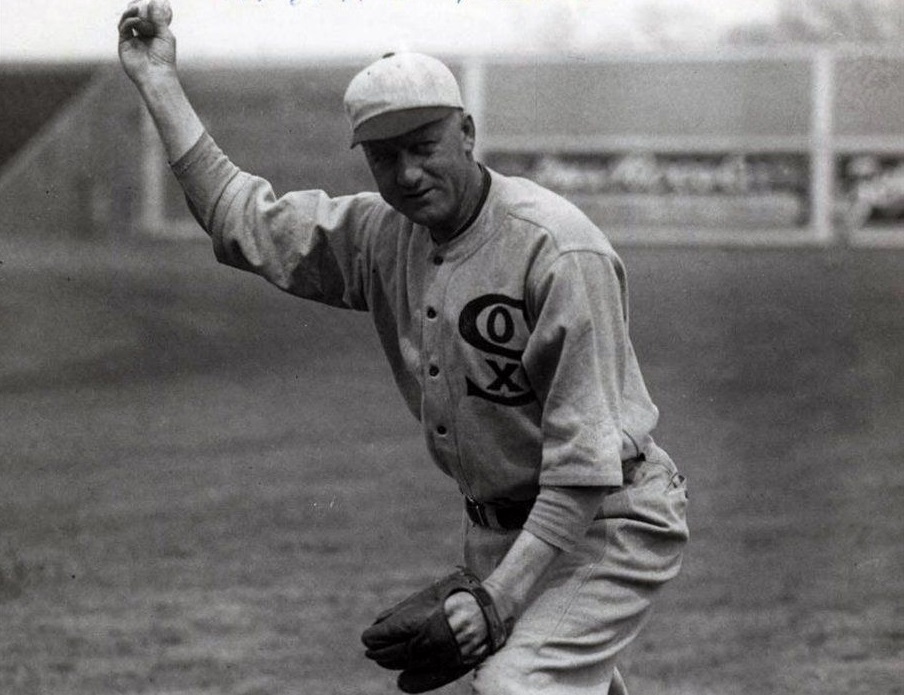
The following season, Faber was expected to continue his dominance, but injuries and military service during World War I limited his playing time. Like many players of his generation, Faber sacrificed part of his career to serve his country, missing most of the 1918 season. When he returned in 1919, he struggled to regain his form and was not a significant part of the White Sox rotation during their infamous pennant-winning season. As a result, he did not play in the 1919 World Series, which became one of the most scandalous events in baseball history due to the Black Sox scandal, where several White Sox players were accused of intentionally losing the series. Faber’s absence from the series is often viewed as a fortunate twist of fate, as his integrity was never questioned, and he remained one of the respected figures in the organization.
In the wake of the Black Sox scandal, the White Sox franchise was devastated by the loss of several key players, including stars like Shoeless Joe Jackson and Eddie Cicotte, who were banned from baseball. The team struggled immensely in the early 1920s, but Faber remained one of the few bright spots. In 1920, baseball banned the spitball, but pitchers who had already been using it were allowed to continue under a grandfather clause. Faber was one of the 17 pitchers who were permitted to throw the pitch legally for the remainder of their careers. His mastery of the spitball gave him a significant advantage, and he continued to be one of the most effective pitchers in the league.
Faber had a resurgence in the early 1920s, proving that he could still dominate despite the changing landscape of baseball. In 1921, he led the American League with a 2.48 ERA and won 25 games, one of the best seasons of his career. He followed that performance with another stellar campaign in 1922, winning 21 games with a 2.81 ERA. Despite the White Sox’s struggles as a team, Faber remained one of the most respected pitchers in baseball.
As he entered his late 30s, Faber’s workload began to decrease, but he remained an effective pitcher well into his 40s. His ability to adapt to the evolving game, relying more on his intelligence and control rather than overpowering stuff, allowed him to extend his career. He continued to pitch for the White Sox through the 1933 season, finishing his career with 254 wins, a 3.15 ERA, and 1,471 strikeouts.

Faber’s legacy is defined by his excellence on the mound, his resilience through various challenges, and his reputation as one of the last great spitball pitchers. His impact on the game extended beyond his playing days, as he helped shape the role of the pitcher in an era when baseball was undergoing significant changes. His contributions to the White Sox were immense, as he was a rare bright spot during a difficult period for the franchise.
In 1964, Faber was inducted into the Baseball Hall of Fame, a well-deserved honor for a pitcher who had been one of the best of his era. His election to Cooperstown ensured that his contributions to the game would not be forgotten. He passed away in 1976 at the age of 88, leaving behind a legacy as one of the great pitchers in baseball history.
Red Faber’s career serves as a testament to perseverance, adaptability, and excellence. From his early days in Iowa to his dominance in the major leagues, he exemplified what it meant to be a great pitcher. His role in the 1917 World Series, his mastery of the spitball, and his ability to remain effective for nearly two decades make him one of the most fascinating figures in baseball history. While he may not be as widely recognized as some of his contemporaries, his impact on the game is undeniable, and his place among the legends of baseball is secure.



 The Baseball Scholar
Leave a comment