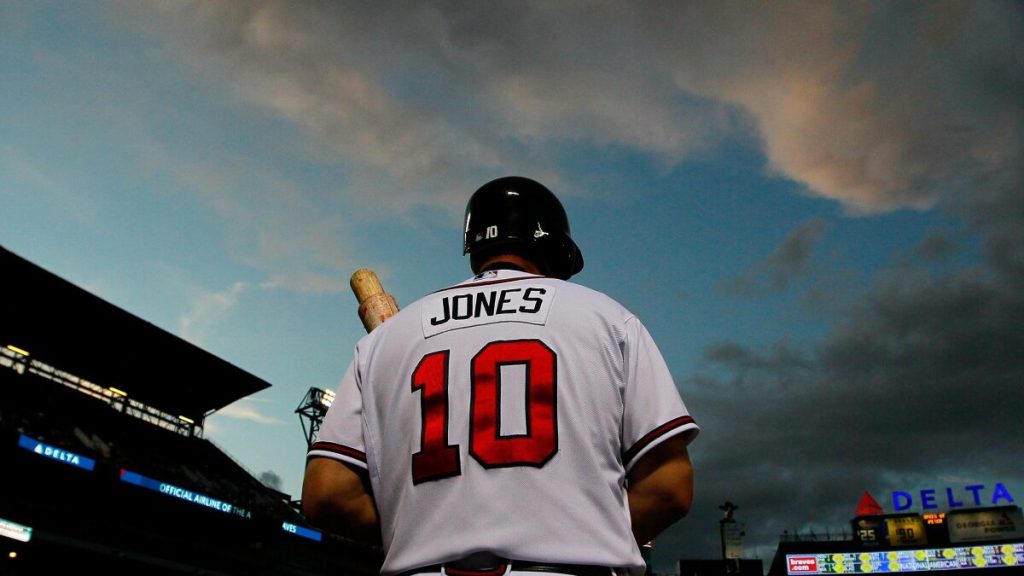
Chipper Jones, one of the greatest switch-hitters in Major League Baseball (MLB) history, crafted a career defined by consistency, power, and a remarkable dedication to his craft. Spending his entire 19-year MLB career with the Atlanta Braves, Jones became the face of the franchise and an enduring symbol of excellence for a generation of baseball fans. His blend of skill, leadership, and charisma made him not just a standout player but an ambassador for the game itself.
From his early days as a promising talent to his ascension as one of baseball’s elite players, Jones achieved success on the field in ways that few have matched. His statistical achievements, including a .303 career batting average, 468 home runs, and 1,623 RBIs, solidify his place among the sport’s legends. However, the impact of Chipper Jones goes beyond numbers. He was a leader in the clubhouse, a consistent performer in the postseason, and a model of loyalty in an era of increasing player movement. This essay delves into Jones’s life and career, exploring his journey to MLB stardom, his statistical dominance, and the profound legacy he left on the game of baseball.
Born Larry Wayne Jones Jr. on April 24, 1972, in DeLand, Florida, Chipper Jones grew up in a baseball-loving family that nurtured his passion for the game. His father, Larry Sr., was a high school baseball coach who instilled in him the fundamentals of the sport from a young age. Chipper’s nickname, derived from being a “chip off the old block,” reflected the close bond he shared with his father and the mentorship that shaped his early development.
As a child, Jones quickly displayed a natural aptitude for baseball. He excelled in youth leagues, earning recognition for his ability to hit from both sides of the plate, his strong arm, and his advanced baseball IQ. By the time he reached high school, it was clear that Jones had the potential to become a professional athlete. He attended The Bolles School in Jacksonville, Florida, where he starred as both a pitcher and a shortstop, leading his team to a state championship and earning accolades as one of the top high school players in the nation.
Jones’s talent caught the attention of MLB scouts, and in the 1990 MLB Draft, the Atlanta Braves selected him with the first overall pick. At the time, the Braves were a struggling franchise in the midst of a rebuild, but they saw in Jones the cornerstone of a brighter future. The decision to draft Jones proved to be a turning point for the organization.
After signing with the Braves, Jones began his professional career in the minor leagues, where he quickly validated the organization’s faith in his potential. Over the next few years, he progressed through the Braves’ farm system, transitioning from shortstop to third base—a move that would define his MLB career. His ability to hit for average and power, combined with his strong defensive instincts, made him a standout prospect.
Jones made his MLB debut on September 11, 1993, at the age of 21. Though his first taste of the majors was brief, it marked the beginning of a journey that would span nearly two decades. Unfortunately, Jones suffered a torn ACL during spring training in 1994, sidelining him for the entire season. The setback was a test of his resilience, but Jones returned stronger than ever, ready to take his place among the Braves’ core players.

The mid-1990s marked the beginning of a golden era for the Atlanta Braves, and Chipper Jones was at the heart of their success. In 1995, his rookie season, Jones hit .265 with 23 home runs and 86 RBIs, helping lead the Braves to a World Series championship. His performance earned him a runner-up finish in the National League Rookie of the Year voting and established him as a key contributor on a team loaded with talent.
The Braves’ dominance during this era was defined by their legendary pitching staff, featuring Greg Maddux, Tom Glavine, and John Smoltz, but Jones provided the offensive firepower that complemented their success on the mound. Over the next several seasons, Jones emerged as one of the league’s premier hitters, combining a keen eye at the plate with the ability to drive the ball to all fields.
Jones’s breakout season came in 1999, when he won the National League Most Valuable Player (MVP) Award. That year, he hit .319 with 45 home runs, 110 RBIs, and a .441 on-base percentage, leading the Braves to another division title. His performance in September, during a heated pennant race, was particularly memorable, as he hit crucial home runs against the New York Mets to solidify the Braves’ playoff position. Jones’s ability to perform in clutch situations became a hallmark of his career.
One of the defining traits of Chipper Jones’s career was his remarkable consistency. Over 19 seasons, he posted a career batting average of .303, making him one of the few players in MLB history to maintain a .300 average over such a long career. His ability to hit from both sides of the plate added to his uniqueness; Jones is widely regarded as one of the greatest switch-hitters in baseball history, alongside legends like Mickey Mantle and Eddie Murray.
Jones’s career totals include 2,726 hits, 468 home runs, and 1,623 RBIs. He also drew 1,512 walks, showcasing his patience and discipline at the plate. His .401 career on-base percentage and .930 OPS (on-base plus slugging) reflect his ability to contribute both as a table-setter and a run producer.

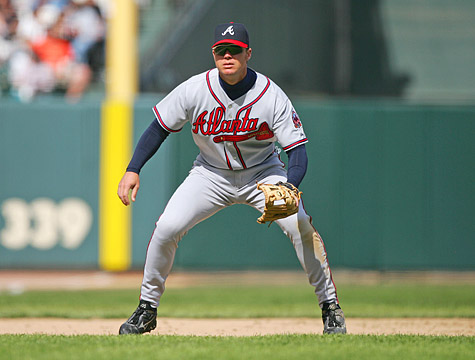
In addition to his offensive prowess, Jones was a capable defender at third base, earning a reputation as a reliable and versatile fielder. Later in his career, he transitioned to left field to accommodate team needs, demonstrating his willingness to put the team’s success above individual accolades.
Chipper Jones was no stranger to the postseason, appearing in 93 playoff games over his career. He played a key role in the Braves’ remarkable run of 14 consecutive division titles from 1991 to 2005, a record that remains unmatched in MLB history. While the Braves won only one World Series during this period, Jones consistently performed well in October, delivering key hits and providing leadership during high-pressure moments.
One of Jones’s most memorable postseason performances came in the 1995 World Series, when the Braves defeated the Cleveland Indians to claim their first championship since moving to Atlanta. As a rookie, Jones demonstrated poise beyond his years, contributing several clutch hits and playing solid defense throughout the series.
Chipper Jones’s impact on the game of baseball extended beyond his statistics. He was a leader in the Braves’ clubhouse, earning the respect of teammates, coaches, and opponents alike. His professionalism and work ethic set an example for younger players, and his loyalty to the Braves organization made him a fan favorite.
Jones’s influence was particularly evident in his ability to mentor emerging talents. Players like Brian McCann and Freddie Freeman credited Jones with helping them navigate the challenges of playing in the major leagues. His presence as a steadying force during times of transition was invaluable to the Braves, who consistently fielded competitive teams during his tenure.

Chipper Jones announced his retirement following the 2012 season, ending his career as one of the most accomplished players in MLB history. His final season was a testament to his enduring skill and determination; at the age of 40, he hit .287 with 14 home runs and 62 RBIs, proving that he could still compete at the highest level.
In 2018, Jones was inducted into the Baseball Hall of Fame in his first year of eligibility, receiving 97.2% of the vote. His induction was a celebration of not just his achievements on the field but also his impact on the game and his unwavering commitment to the Braves organization.
Chipper Jones’s career is a story of excellence, loyalty, and a deep love for the game of baseball. From his early days as a promising prospect to his emergence as one of the greatest players of his generation, Jones consistently delivered performances that thrilled fans and elevated his team. His statistical achievements, including a .303 career batting average, 468 home runs, and 1,623 RBIs, place him among the sport’s all-time greats.

Beyond the numbers, Jones’s leadership, professionalism, and dedication to the Atlanta Braves made him a beloved figure in the baseball community. His legacy as one of the greatest switch-hitters and a cornerstone of the Braves’ golden era ensures that his name will be celebrated for generations to come. Chipper Jones was more than just a player; he was an icon whose impact on the game of baseball transcends his time on the field.



 The Baseball Scholar
Leave a reply to 2000s All-Decade Team – The Baseball Scholar Cancel reply