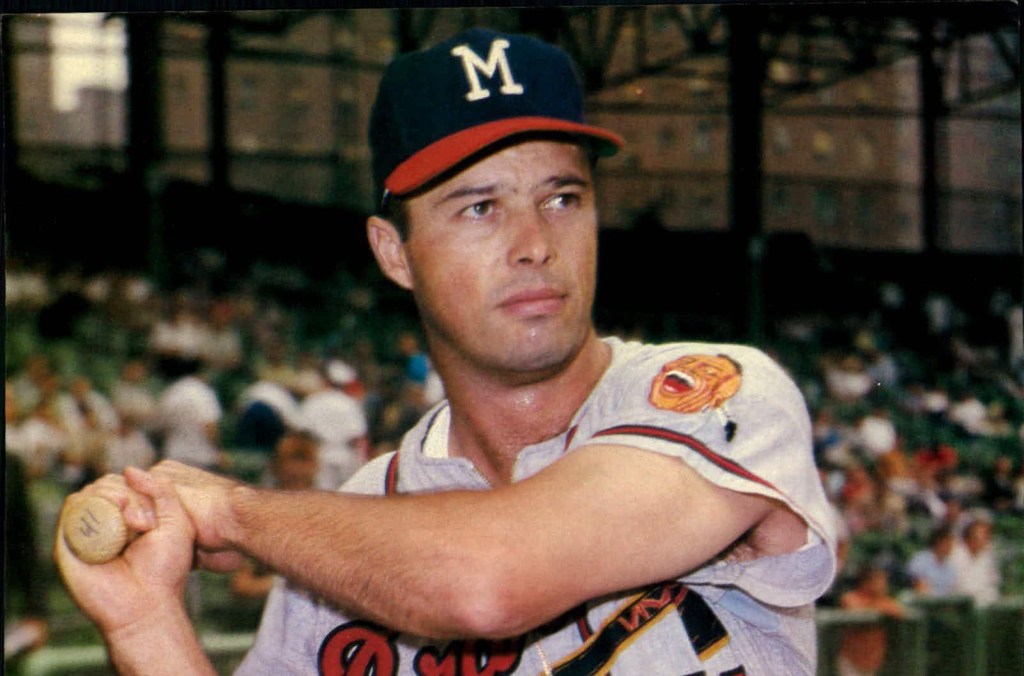
Eddie Mathews stands as one of the greatest power hitters in Major League Baseball (MLB) history and a cornerstone of the game during the mid-20th century. Over a career that spanned 17 seasons, from 1952 to 1968, Mathews displayed an unparalleled ability to combine raw power with a keen batting eye, solidifying his legacy as one of the premier third basemen in the history of the sport. A two-time World Series champion and a 12-time All-Star, Mathews left an indelible mark on baseball, not only with his achievements at the plate but also with his leadership and influence on the development of the third base position.
Edwin Lee Mathews was born on October 13, 1931, in Texarkana, Texas, and grew up in Santa Barbara, California. From an early age, Mathews demonstrated a natural talent for baseball. His father, a former semipro player, encouraged Eddie’s interest in the sport and helped him develop his skills. Mathews’ left-handed swing was one of his most noticeable traits, showcasing a power and fluidity that would define his career.

Mathews attended Santa Barbara High School, where he excelled in baseball, football, and basketball. It was on the baseball diamond, however, where he truly shone. He caught the attention of scouts with his towering home runs and ability to make consistent hard contact. Upon graduating, Mathews signed with the Boston Braves in 1949, beginning his professional baseball journey. His development in the Braves’ minor league system was rapid. Mathews dominated at every level, displaying the raw power and plate discipline that would make him a star in the majors.
Mathews made his MLB debut with the Braves in 1952, the team’s last year in Boston before moving to Milwaukee. His debut was a signal of things to come, as he hit 25 home runs and drove in 58 runs in his rookie season. This impressive performance set the stage for one of the most illustrious careers in baseball history. Despite his youth, Mathews exhibited a poise and professionalism that belied his age, earning him a permanent spot in the Braves’ lineup.
Eddie Mathews’ MLB career was defined by his remarkable power-hitting ability, consistency, and longevity. Over 17 seasons, he played for the Braves, the Houston Astros, and the Detroit Tigers. He finished his career with 512 home runs, becoming only the seventh player in MLB history to reach the 500-home run milestone at the time. His career batting line of .271/.376/.509, with an OPS of .885, reflects his combination of power and patience. Mathews walked more than 100 times in six different seasons, demonstrating a keen eye at the plate that complemented his slugging prowess.
In 1953, Mathews’ second season in the majors, he broke out as one of the league’s most feared hitters. That year, he hit 47 home runs, drove in 135 runs, and posted a .302 batting average. At just 21 years old, Mathews became the youngest player ever to lead the National League in home runs, a record that still stands today. This performance solidified his reputation as a generational talent and marked the beginning of a run of dominance that would span over a decade.
Mathews was one of the key players on the Milwaukee Braves teams of the 1950s and early 1960s, alongside future Hall of Famer Hank Aaron. The duo formed one of the most potent offensive tandems in baseball history, leading the Braves to multiple postseason appearances and a World Series championship in 1957. Mathews played an integral role in the Braves’ success, hitting 32 home runs and driving in 94 runs during the 1957 regular season. In the World Series that year, he delivered a crucial game-winning home run in Game 4 against the New York Yankees, helping secure the Braves’ only championship during their time in Milwaukee.
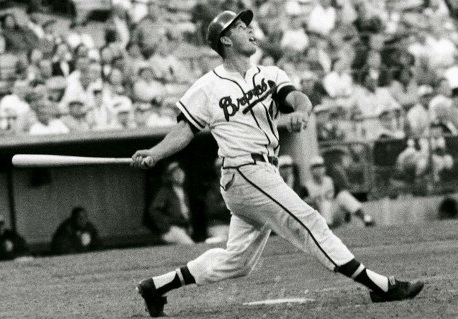
Mathews’ consistency at the plate was remarkable. He hit 30 or more home runs in nine consecutive seasons from 1953 to 1961 and reached the 100-RBI mark five times during that span. His power was not limited to home runs; he was also an extra-base hit machine, finishing his career with 1,133 extra-base hits, which ranks among the all-time leaders. Additionally, Mathews’ ability to get on base made him a well-rounded offensive player. He drew over 1,400 walks in his career, a testament to his disciplined approach and ability to work deep counts against pitchers.
Throughout his career, Mathews had numerous moments of brilliance that showcased his immense talent and competitive spirit. One of his most memorable performances came during the 1953 season, when he hit three home runs in a single game against the Brooklyn Dodgers at Ebbets Field. This feat underscored Mathews’ ability to rise to the occasion and dominate some of the best teams and pitchers of his era.
Another defining moment came in 1967, during Mathews’ stint with the Detroit Tigers. Late in the season, Mathews hit his 500th career home run, becoming just the second third baseman in MLB history to reach that milestone after Mike Schmidt. This achievement was a crowning moment in Mathews’ career and solidified his status as one of the greatest power hitters of all time.
Mathews was also known for his durability and ability to perform in pressure situations. He appeared in 2,391 games during his career and consistently delivered in clutch moments, particularly during the postseason. His leadership and composure were instrumental in helping the Braves contend year after year, and his performances in key games often provided the spark his team needed.
Eddie Mathews was not only a dominant player but also a colorful and respected figure in the baseball world. Known for his competitive nature and fiery personality, Mathews was a leader both on and off the field. He was a vocal presence in the clubhouse and often took younger players under his wing, offering guidance and support as they adjusted to life in the majors.
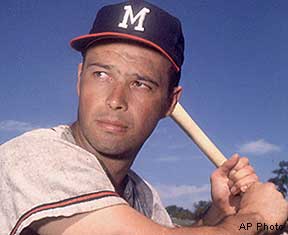
One famous anecdote about Mathews involves a brawl with Frank Robinson during a game in 1960. Mathews, known for his toughness, stood his ground and famously said, “I never backed down from anyone, and I wasn’t going to start then.” This incident exemplified Mathews’ fearless attitude and his unwillingness to be intimidated by anyone, no matter their stature in the game.
Mathews’ sense of humor and humility also endeared him to teammates and fans alike. Despite his status as a superstar, he was known for his approachable demeanor and willingness to engage with fans. His playful banter with Hank Aaron became a hallmark of their partnership, and the two developed a deep friendship that lasted long after their playing days ended.
Eddie Mathews’ impact on baseball extended far beyond his impressive statistics. As one of the first players to make third base a power-hitting position, Mathews helped redefine the expectations for players at the hot corner. Before Mathews, third basemen were often valued more for their defensive abilities than their offensive contributions. Mathews, with his prodigious power and run-producing capabilities, demonstrated that a third baseman could be a cornerstone of a team’s lineup.
Mathews’ influence on the game can also be seen in the players who followed in his footsteps. Future generations of power-hitting third basemen, including Mike Schmidt, George Brett, and Chipper Jones, have cited Mathews as an inspiration and role model. His ability to combine offensive dominance with solid defensive play set a standard that many have sought to emulate.
In addition to his contributions on the field, Mathews also made an impact as a manager. After retiring as a player, he managed the Atlanta Braves from 1972 to 1974, becoming one of the few Hall of Famers to transition to a managerial role. While his tenure as a manager was relatively short, Mathews’ leadership and knowledge of the game were evident, and he remained a respected figure in the baseball community.

Eddie Mathews’ MLB career was one of extraordinary achievement and lasting influence. His 512 home runs, 12 All-Star selections, and role in the Milwaukee Braves’ 1957 World Series championship are just a few of the highlights of his storied career. Mathews’ ability to combine power, patience, and consistency at the plate made him one of the greatest hitters of his era and one of the finest third basemen in baseball history.
Beyond his individual accomplishments, Mathews helped reshape the expectations for the third base position and inspired future generations of players. His toughness, leadership, and passion for the game made him a beloved figure among fans and teammates alike. Eddie Mathews’ legacy as a trailblazer and a Hall of Fame talent will forever be remembered as an integral part of baseball history.



 The Baseball Scholar
Leave a comment