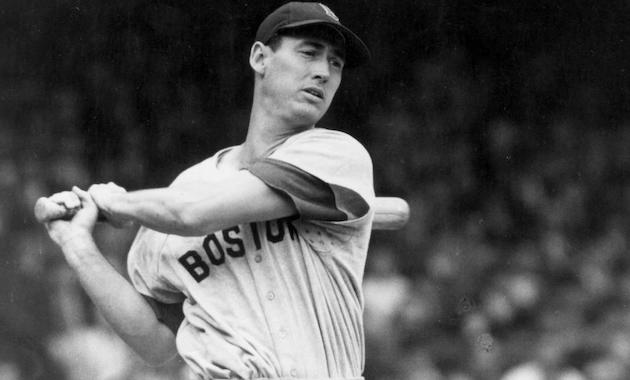
Ted Williams, often referred to as “The Splendid Splinter,” is one of the most iconic and accomplished hitters in Major League Baseball history. Williams’ career with the Boston Red Sox, spanning from 1939 to 1960, remains a benchmark for offensive excellence. Known for his incredible batting eye, unparalleled swing, and deep understanding of the game, Williams redefined hitting and left an indelible mark on baseball.
Statistically, Ted Williams’ career is one of extraordinary achievement. Over 19 seasons (interrupted by military service during World War II and the Korean War), Williams compiled a .344 career batting average, the highest among players in the live-ball era, and ranks 10th in MLB history. He hit 521 home runs, drove in 1,839 runs, and amassed 2,654 hits. Williams remains the last player to hit .400 in a season, a feat he achieved in 1941 with a .406 batting average. That season is widely regarded as one of the greatest in baseball history, as Williams also led the league in on-base percentage (.553) and slugging percentage (.735), showcasing his ability to combine contact and power like no other player of his time.

Williams’ command of the strike zone was unparalleled, reflected in his career on-base percentage (OBP) of .482, the highest in MLB history. His discipline at the plate allowed him to draw 2,021 walks while striking out just 709 times, an extraordinary ratio that underscores his exceptional approach to hitting. Williams won six batting titles and led the league in OBP 12 times, further solidifying his reputation as the greatest hitter of his era.
Despite losing nearly five full seasons to military service, Williams’ accomplishments are staggering. He won two American League Most Valuable Player (MVP) Awards, in 1946 and 1949, and was a 19-time All-Star. Williams also won the Triple Crown twice, in 1942 and 1947, leading the league in batting average, home runs, and RBIs in the same season—a feat few players in baseball history have achieved even once. His career totals would likely have been even more impressive had his service in the U.S. Navy and Marine Corps not interrupted his prime years.
Beyond his remarkable statistics, Ted Williams’ impact on baseball is profound. He was a student of the game and approached hitting with a scientific precision that revolutionized how players and coaches think about the craft. Williams authored The Science of Hitting, a seminal book that remains influential in teaching the fundamentals of hitting. His emphasis on studying pitchers, understanding pitch locations, and maintaining a disciplined swing inspired generations of players and coaches.

Williams’ personality and career were not without controversy. Known for his fiery demeanor and occasional clashes with fans and the media, he was unapologetically focused on excellence. This intensity, however, endeared him to teammates and demonstrated his unwavering commitment to being the best. His refusal to tip his cap to the crowd, a symbolic act of defiance against what he perceived as unfair criticism, added complexity to his legacy.
Ted Williams’ influence extended beyond the baseball diamond. His military service, including combat missions as a fighter pilot during World War II and the Korean War, exemplified his character and patriotism. Few athletes have balanced such an illustrious sports career with the demands of military duty, making Williams a unique figure in American history. His return to baseball after each war and subsequent success underscored his resilience and exceptional talent.

In 1966, Williams was inducted into the Baseball Hall of Fame in his first year of eligibility, receiving one of the highest vote percentages ever at the time. His legacy as one of the greatest players to ever grace the game remains intact, and his name is synonymous with hitting excellence. The Boston Red Sox honored Williams by retiring his number 9, and Fenway Park remains a shrine to his achievements.
Ted Williams’ MLB career is a remarkable story of talent, dedication, and influence. His .406 batting average in 1941, six batting titles, two Triple Crowns, and .482 career on-base percentage are unmatched achievements that solidify his place among baseball’s all-time greats. Beyond his stats, Williams’ impact on the art of hitting and his service to his country make him a towering figure in American sports history. Ted Williams will forever be remembered as the quintessential hitter and a symbol of excellence in Major League Baseball.




 The Baseball Scholar
Leave a comment