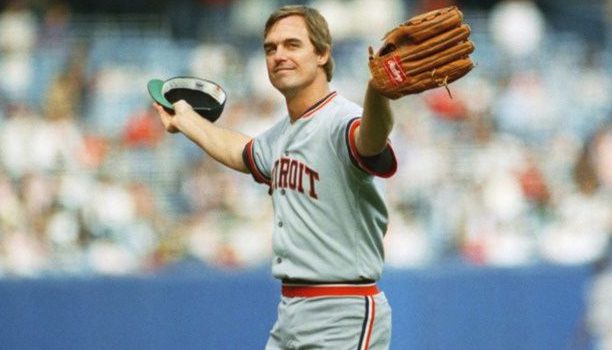
Frank Tanana’s Major League Baseball career is one of the most fascinating and unique trajectories in the history of the sport. Over the course of 21 seasons, Tanana reinvented himself more than once, transforming from a flame-throwing strikeout artist into a crafty finesse pitcher with elite longevity. His story is not only about endurance but also about intelligence, adaptability, and a deep understanding of the game. With 240 career wins, 2,773 strikeouts, and 616 games started, Tanana’s numbers are substantial. Yet his impact goes beyond statistics, encompassing a personal transformation and a reputation for professionalism that left a lasting imprint on every team he played for.
Frank Daryl Tanana was born on July 3, 1953, in Detroit, Michigan. His father, Frank Tanana Sr., was a professional basketball player and a tremendous influence on young Frank, instilling in him a competitive spirit and an early appreciation for athletics. Tanana was a standout in multiple sports during his youth, but his left arm quickly became his calling card. He attended Detroit Catholic Central High School, where he dominated on the mound, earning a scholarship to play baseball at Indiana University. However, he never suited up for the Hoosiers, as he was drafted in the first round (13th overall) of the 1971 MLB Draft by the California Angels.

Tanana quickly rose through the Angels’ minor league system and made his MLB debut on September 9, 1973, at just 20 years old. By the mid-1970s, he had formed one of the most formidable one-two pitching punches in baseball alongside Nolan Ryan. While Ryan was known for his overpowering fastball and astronomical strikeout totals, Tanana matched him with his own electric velocity and pinpoint control. From 1974 through 1977, Tanana was one of the best pitchers in the American League. In 1975, he led the league in strikeouts with 269 and posted a 2.62 ERA with 16 wins. The following year, 1976, was arguably his best: he finished with a 19-10 record, a 2.43 ERA, 261 strikeouts, and seven shutouts. He made the All-Star team in three consecutive seasons from 1976 to 1978 and was considered a future Cy Young contender.
However, the wear and tear of throwing so many high-velocity innings at such a young age began to take its toll. Tanana suffered arm and shoulder injuries that robbed him of his fastball by the early 1980s. Many pitchers would have seen their careers stall or end altogether, but Tanana did something remarkable: he reinvented himself as a soft-tossing, off-speed specialist. He adopted a wide array of breaking balls, off-speed pitches, and impeccable location, which allowed him to remain effective for well over a decade after his days as a fireballer were over.
After his early success with the Angels, Tanana was traded to the Boston Red Sox in 1980, but his time there was brief. He signed with the Texas Rangers in 1982 and pitched there for three seasons. While he wasn’t the dominant ace he once was, he became a reliable innings-eater and a calming veteran presence in the rotation. By this time, his velocity had diminished considerably, but his ability to read hitters and execute game plans had matured to an elite level.

In 1985, Tanana signed with his hometown team, the Detroit Tigers, and would spend the next eight seasons there, providing steady production in the middle and back end of the rotation. His years with the Tigers were marked by durability and professionalism. From 1985 to 1992, he started over 200 games and consistently logged over 180 innings per season. He wasn’t blowing hitters away anymore, but he understood the art of pitching perhaps better than ever. One of the highlights of his time in Detroit came on October 3, 1987, when he pitched a complete-game shutout against the Toronto Blue Jays on the final day of the regular season. That win clinched the American League East title for the Tigers, a game often remembered as one of the most clutch performances of Tanana’s career.
Tanana’s statistical achievements are noteworthy. Over his 21-year career, he accumulated a record of 240-236 with a career ERA of 3.66 across 4,188.2 innings pitched. He started 616 games, ranking among the top 30 in MLB history. He struck out 2,773 batters, placing him high on the all-time list at the time of his retirement. Though he never won a Cy Young Award, his early career performance put him in the discussion, and his late-career consistency added to his value. He had four seasons with over 200 strikeouts and logged double-digit victories in 13 seasons.
Despite his longevity and impressive numbers, Tanana never garnered significant Hall of Fame consideration, likely because he lacked the peak dominance across a longer stretch that voters often look for. Additionally, his career record of 240-236 may not immediately catch the eye. However, those numbers belie the context of the teams he pitched for—many of which were not playoff contenders—and the different phases of his career. Few pitchers have ever had such a stark transition from overpowering ace to veteran craftsman, and fewer still have succeeded in both roles over such an extended period.

Off the field, Tanana underwent a personal transformation that was just as significant as his professional one. In the early 1980s, amid the challenges of adjusting to life without his once-dominant fastball, Tanana became a born-again Christian. This spiritual awakening had a profound effect on his outlook and demeanor. He became deeply involved in charitable work, mentorship, and public speaking, often discussing his faith and the role it played in his career. He was known as a positive clubhouse influence and someone younger players could look to for guidance. His post-baseball life continued in this vein, as he worked with youth ministries and charitable organizations, focusing on helping others find purpose beyond the game.
There are countless anecdotes from teammates and opponents alike that speak to Tanana’s intelligence and competitive fire. One such story involves Hall of Famer George Brett, who once noted that Tanana, even without his fastball, was one of the toughest pitchers to face because of his ability to change speeds and hit his spots. Hitters couldn’t rely on rhythm or anticipation; Tanana disrupted timing like few others could. Another often-repeated tale is how Tanana used to joke about the radar gun. Early in his career, he could light it up; later, he quipped that radar guns no longer read speeds that low. His self-deprecating humor and humility endeared him to teammates and media alike.
Tanana’s role as a mentor and clubhouse leader cannot be understated. During his time with the Tigers, he was often tasked with guiding young pitchers, showing them the mental side of the game and how to prepare meticulously for each start. He was an example of professionalism in every aspect, from his work ethic to his pre-game preparation and post-game analysis. In an era before advanced analytics became widespread, Tanana relied on intuition, observation, and experience to outthink hitters. He helped instill that approach in those around him.

His durability and ability to adapt also make him a fascinating case study in baseball history. Very few pitchers have ever succeeded in two completely different incarnations within the same career. The young Frank Tanana, who once outpaced Nolan Ryan in strikeouts and ERA, was a completely different pitcher from the veteran Frank Tanana who baffled hitters with off-speed pitches and savvy in his 30s and 40s. That dual identity makes his career one of the most unique and illustrative examples of the varied paths success in baseball can take.
In the grand narrative of MLB, Frank Tanana’s name may not come up as frequently as it should, but those who followed his career closely understand the magnitude of what he accomplished. He is a reminder that greatness in baseball is not always defined by dominance or accolades but sometimes by perseverance, reinvention, and the ability to excel under changing circumstances. His story is rich with lessons about adaptation, humility, and leadership.
Frank Tanana’s MLB career stands as a testament to the enduring power of reinvention. From a hard-throwing phenom to a soft-tossing tactician, from a young star to a veteran mentor, Tanana’s journey through baseball is a masterclass in resilience and evolution. His legacy may not be carved in Cooperstown, but it is deeply embedded in the memories of teammates, opponents, and fans who witnessed a true craftsman ply his trade with excellence for over two decades. His contributions to the game, both on and off the field, continue to resonate long after his final pitch.



 The Baseball Scholar
Leave a comment