
Fred Lynn was one of the most naturally gifted outfielders of his generation, a player whose combination of power, defense, and athleticism made him one of the most exciting players in Major League Baseball during the 1970s and 1980s. Best known for his time with the Boston Red Sox, Lynn made an immediate impact on the game, becoming the first player in MLB history to win both the Rookie of the Year and the Most Valuable Player award in the same season. Over a 17-year career that spanned multiple teams, he compiled impressive statistics, provided memorable moments, and left a lasting impact on the game. Despite battling injuries throughout his career, Lynn’s contributions to baseball remain significant, and his legacy as one of the best center fielders of his era is well cemented.
Fredric Michael Lynn was born on February 3, 1952, in Chicago, Illinois. However, his family moved to Southern California when he was young, and it was there that he developed into a baseball star. Growing up in El Monte, California, Lynn played multiple sports, but baseball was where he truly excelled. He attended El Monte High School and quickly gained a reputation as one of the best young players in the area. His talent earned him an opportunity to play college baseball at the University of Southern California (USC), one of the premier baseball programs in the country.

At USC, Lynn was part of a powerhouse team that won the College World Series in 1971 and 1972. Coached by the legendary Rod Dedeaux, the Trojans were known for producing top-tier talent, and Lynn was no exception. Playing alongside future MLB stars like Roy Smalley, Lynn developed into one of the best collegiate players in the country. His smooth left-handed swing, excellent outfield instincts, and all-around athleticism made him a highly sought-after prospect. In the 1973 MLB Draft, the Boston Red Sox selected him in the second round, recognizing his immense potential.
Lynn progressed quickly through the Red Sox minor league system, and by the end of the 1974 season, he had earned a late-season call-up to the major leagues. In just 15 games, he gave the Red Sox a glimpse of what was to come, hitting .419 with two home runs. The following year, in 1975, Lynn had one of the greatest rookie seasons in baseball history. He played in 145 games, hitting .331 with 21 home runs, 105 RBIs, 47 doubles, and an OPS of .967. His all-around brilliance earned him both the American League Rookie of the Year and MVP awards, making him the first player ever to win both honors in the same season.
Lynn’s rookie campaign was not only about statistics; it was also about his impact on the team. He helped lead the Red Sox to the American League pennant, marking their first trip to the World Series since 1967. His defensive prowess in center field was extraordinary, as he showcased an ability to cover ground effortlessly and make spectacular catches. He won his first Gold Glove Award in 1975, further cementing his reputation as one of the best all-around players in the game.
The 1975 World Series between the Red Sox and Cincinnati Reds remains one of the most memorable in baseball history. While the series is often remembered for Carlton Fisk’s dramatic walk-off home run in Game 6, Lynn also played a crucial role. He hit .280 with a home run and five RBIs in the series, contributing to Boston’s strong performance. Unfortunately, the Red Sox fell short, losing in seven games, but Lynn’s performance on the national stage established him as one of the game’s brightest young stars.
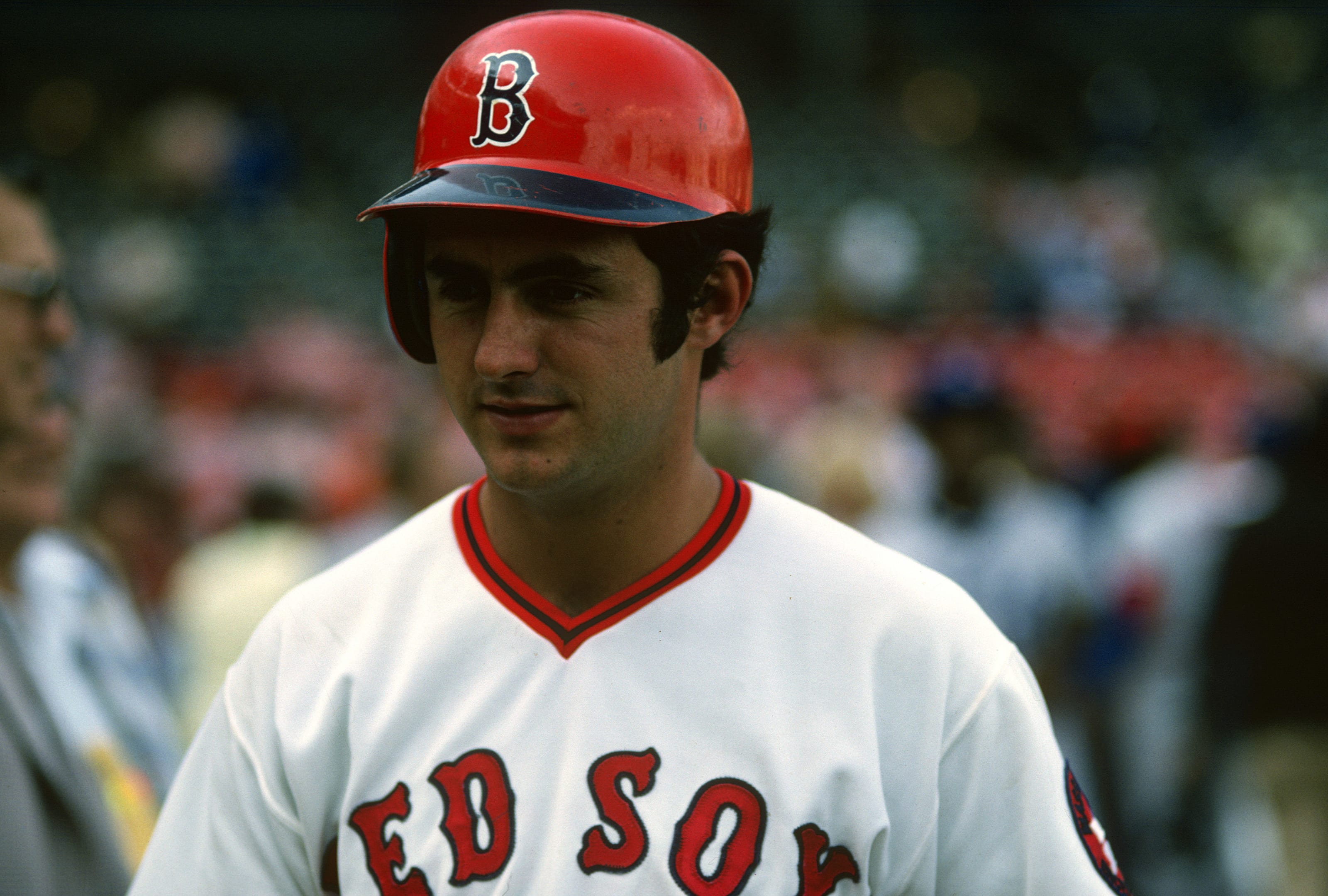
Over the next several seasons, Lynn continued to be a force for the Red Sox. In 1976, he hit .314 with 10 home runs, though injuries limited him to 132 games. He rebounded in 1977 with an even better season, batting .260 with 18 home runs and 76 RBIs while continuing to provide elite defense. By 1978, Lynn was fully entrenched as one of the best center fielders in the game. That year, he hit .298 with 22 home runs and 82 RBIs, helping lead the Red Sox into a dramatic playoff race with the New York Yankees.
The 1978 season ended in heartbreak for the Red Sox, as they lost a one-game playoff to the Yankees after blowing a late-season lead in the AL East. Despite the disappointment, Lynn continued to shine, both offensively and defensively. He won four consecutive Gold Gloves from 1975 to 1979, showcasing his exceptional range and instincts in the outfield.
Lynn’s best statistical season came in 1979 when he put up career-best numbers across the board. He batted .333 with 39 home runs, 122 RBIs, and an OPS of 1.059. He led the American League in batting average, slugging percentage, and OPS, earning his second All-Star Game MVP award (he had also won it in 1976). That season reaffirmed his status as one of the best players in baseball, and he finished fourth in MVP voting.
Despite his individual brilliance, Lynn and the Red Sox never won a World Series together. After the 1980 season, in a controversial move, the Red Sox traded him to the California Angels in a deal that sent shockwaves through baseball. The trade was financially motivated, as Lynn sought a more lucrative contract than the Red Sox were willing to offer. In return, Boston received Joe Rudi, Frank Tanana, and Jim Dorsey.

Lynn’s tenure with the Angels from 1981 to 1984 was productive, though he was often hampered by injuries. In his first season with the Angels, he battled through a strike-shortened year, hitting .219 with five home runs. However, he bounced back in 1982, hitting .299 with 21 home runs and 86 RBIs while helping lead the Angels to the ALCS. In the postseason, Lynn continued to be a clutch performer, batting .611 in the series against the Milwaukee Brewers, though the Angels ultimately fell short.
Lynn played two more solid seasons with the Angels before signing with the Baltimore Orioles in 1985. While he remained a productive hitter, injuries continued to take their toll. His best season in Baltimore came in 1986 when he hit .287 with 23 home runs and 67 RBIs. Despite his strong play, the Orioles struggled to compete, and Lynn’s time in Baltimore was relatively uneventful.
In 1988, Lynn signed with the Detroit Tigers, where he played for two seasons. While his skills had diminished somewhat, he remained a respected veteran presence and a solid contributor. His final MLB season came in 1990 with the San Diego Padres, after which he retired from professional baseball.
Over the course of his career, Lynn compiled a .283 batting average, 306 home runs, and 1,111 RBIs. He was a nine-time All-Star, a four-time Gold Glove winner, and one of the most complete players of his generation. While injuries prevented him from reaching even greater statistical milestones, his impact on the game was undeniable.

Beyond his numbers, Lynn helped redefine what it meant to be a center fielder, combining elite defense with significant power and offensive production. His rookie season remains one of the greatest in MLB history, and his contributions to the Red Sox during the 1970s played a key role in the team’s resurgence.
Though he has not been inducted into the Hall of Fame, many consider him one of the best players not in Cooperstown. His combination of talent, charisma, and championship-level play made him a fan favorite wherever he went. Today, he remains a respected figure in baseball circles, often appearing at Red Sox events and serving as an ambassador for the game.
Fred Lynn’s career may not have included a World Series title, but his impact on baseball is undeniable. He remains one of the most exciting and talented players of his era, a player who set a standard for excellence in center field and left a lasting legacy in the game.


 The Baseball Scholar
Leave a comment