
Barry Larkin, widely considered one of the finest shortstops to ever play Major League Baseball (MLB), had a career that spanned 19 seasons, all of which he spent with the Cincinnati Reds. A player known for his leadership, defensive brilliance, and offensive consistency, Larkin became a symbol of excellence in the game. Throughout his career, Larkin exhibited the kind of all-around skill set that set him apart from other players at his position. He was a true five-tool player, capable of hitting for average, power, stealing bases, and playing stellar defense.
Barry Louis Larkin was born on April 28, 1964, in Cincinnati, Ohio. Growing up in a baseball-rich region, Larkin developed a love for the game at a young age. His father, an African American from the Midwest, had a deep appreciation for sports, and the family environment fostered an interest in athletics from early childhood. Larkin attended Archbishop Moeller High School, where he played baseball and was recognized for his exceptional athleticism. While his high school team was consistently competitive, it was Larkin’s skills that set him apart. As a shortstop, he displayed a unique combination of speed, power, and agility—qualities that would make him a standout at the next level.

Larkin’s high school success did not go unnoticed, and he was highly recruited by college scouts. He chose to attend the University of Michigan, where he played for the Michigan Wolverines baseball team. At Michigan, Larkin continued to develop his skills, further refining his abilities both defensively and offensively. He was a star player, earning All-American honors and showing his versatility as a shortstop. Larkin’s strong showing in college baseball drew the attention of major league scouts, and he was selected by the Cincinnati Reds in the first round of the 1985 MLB Draft with the fourth overall pick.
Larkin’s ascent to the major leagues was swift. He played just one season in the minor leagues before making his MLB debut with the Cincinnati Reds on August 31, 1986. His early years in the major leagues showed promise, but like most young players, Larkin faced challenges as he adjusted to the competition at the highest level. In his first full season in 1987, Larkin appeared in 125 games for the Reds, hitting .254 with 11 home runs and 54 RBIs. Although the Reds did not have immediate success as a team, Larkin’s potential was evident.
Over the next several seasons, Larkin continued to develop as both a hitter and a fielder. His offensive production improved year after year, as he became more comfortable in the batter’s box and showed the ability to hit for average and power. More importantly, Larkin established himself as one of the best defensive shortstops in the league, earning his first Gold Glove Award in 1988. His exceptional range, quick reflexes, and strong arm made him a dynamic force in the field, and he became known for his ability to turn double plays with precision.
Larkin’s growing stature within the league was reflected in his recognition as a top player at his position. In 1990, he had one of his best seasons, hitting .301 with 10 home runs and 50 RBIs while finishing 9th in the National League MVP voting. The Reds, with Larkin anchoring their infield, went on to dominate the National League, winning the 1990 World Series in a stunning four-game sweep of the Oakland Athletics. Larkin played a pivotal role in that victory, showcasing his leadership and clutch play in key moments.

The 1990s marked the prime of Barry Larkin’s career. He became one of the league’s most consistent and respected players, combining his defensive prowess with ever-improving offensive skills. During this period, Larkin began to emerge as one of the most complete shortstops in the game. His offensive statistics were consistently strong, and he became known for his ability to hit for both average and power, while maintaining a disciplined approach at the plate.
From 1991 to 1999, Larkin averaged more than 150 hits per season and consistently posted on-base percentages above .350. He became a fixture atop the Reds’ lineup, using his speed and ability to get on base to set the stage for other hitters. Larkin was also a threat on the base paths, consistently stealing between 20 and 30 bases per year during his peak. This ability to impact the game in multiple facets made him a true five-tool player. In 1995, he had one of his most impressive all-around seasons, hitting .319 with 15 home runs, 66 RBIs, and 51 stolen bases. He finished third in the National League MVP voting, cementing his status as one of the top players in baseball.
The 1995 season also marked a personal milestone for Larkin. Not only did he lead the Reds to the National League Central Division title, but he was also named the National League’s Most Valuable Player that year. His outstanding performance in both the field and at the plate helped the Reds secure their place in the postseason. Larkin’s MVP award was well-deserved, as he was instrumental in both the Reds’ offensive attack and their defensive success.
Larkin’s bat continued to impress throughout the 1990s. He became known as one of the best shortstops in the game for his ability to hit for power, amassing 10 or more home runs in nine seasons throughout his career. Larkin also proved to be a reliable run producer, driving in key runs when his team needed it most. In addition to his consistent offensive numbers, Larkin’s defense remained elite. He continued to win Gold Gloves, demonstrating that his contributions to the Reds were not confined to just his bat, but also his ability to play the game at an incredibly high level on defense. By the end of the 1990s, Larkin had solidified his place as one of the top shortstops in baseball.
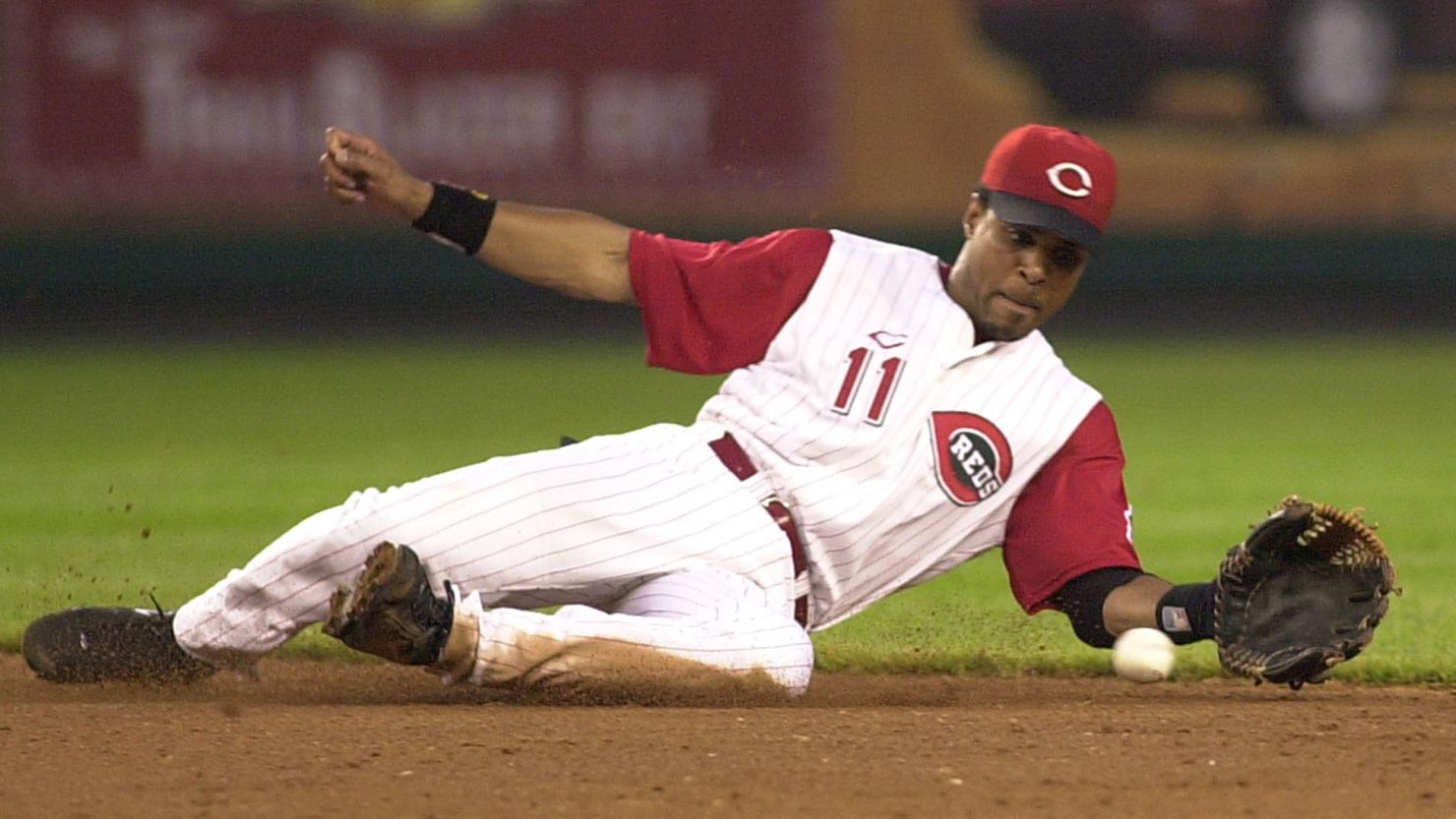
As Larkin entered the new millennium, his career began to shift. The Reds were not as dominant as they had been in the previous decade, and Larkin’s age was starting to catch up with him. He was no longer the dynamic force he had once been, but he remained an important figure in the Reds’ clubhouse. Even in his later years, Larkin’s leadership qualities stood out. His presence in the locker room and his ability to guide younger players were instrumental in keeping the team competitive during a transitional period.
Though his physical abilities began to decline, Larkin remained a valuable contributor on the field. He was still able to hit for average and provide leadership and stability at the shortstop position. His speed and base-stealing ability started to fade, but he remained an effective bat in the Reds’ lineup, offering a veteran presence to complement the team’s emerging talent. Larkin also continued to be a stellar defensive player, though his range and arm strength were not what they had been in his prime. However, his fielding IQ, positioning, and leadership still made him an asset at shortstop.
Larkin’s contributions to the Reds remained significant in the early 2000s. In 2000, he hit .305 and provided leadership as one of the team’s key players. However, by 2004, Larkin had become a part-time player, often relegated to a utility role or platoon status. Despite this, he continued to provide value with his leadership and clutch performances, and in his final years, he became a mentor to younger shortstops.
Barry Larkin officially announced his retirement from Major League Baseball in 2004 after 19 seasons with the Reds. His decision to retire marked the end of an era for the Cincinnati Reds, as Larkin had been the face of the franchise for nearly two decades. He left the game with an impressive career that included 12 All-Star appearances, 9 Gold Gloves, and an MVP award. Larkin’s career batting average of .295, along with his 2,340 hits, 198 home runs, and 960 RBIs, reflected his status as one of the game’s top shortstops. His defensive abilities were also among the best in the league, as evidenced by his numerous Gold Gloves.

Perhaps one of the most significant aspects of Larkin’s legacy is the way in which he represented the shortstop position. At a time when the position was often associated with defensive prowess over offensive output, Larkin showed that a shortstop could excel in both areas. His combination of offense, defense, and leadership made him one of the most complete players to ever play the game.
Larkin’s impact on baseball extends beyond just his statistical achievements. He became a role model for future generations of shortstops and infielders, and his success was emblematic of the value of well-rounded players in modern baseball. His leadership both on and off the field was integral to the success of the Reds during the 1990s, and his place as a key figure in the franchise’s history is well-established.
In 2012, Larkin was inducted into the Baseball Hall of Fame, a fitting recognition of his outstanding career. His election was a testament to the respect and admiration he earned throughout his career, both from fans and fellow players. Larkin’s Hall of Fame induction was a crowning achievement in a career that had already seen numerous accolades and honors.

Barry Larkin’s career in Major League Baseball stands as a testament to his skill, work ethic, and dedication to the game. From his early days in Cincinnati to his rise as one of the best shortstops in the game, Larkin’s career was defined by his exceptional defense, his offensive consistency, and his leadership. His place in baseball history is secure, as he revolutionized the shortstop position by proving that a player could excel offensively and defensively, while also serving as a vital leader for his team. Larkin’s impact on the game, both as a player and as a mentor, extends far beyond his career statistics. As one of the all-time greats at his position, Barry Larkin will forever be remembered as a player who exemplified everything that is great about the game of baseball.




 The Baseball Scholar
Leave a comment