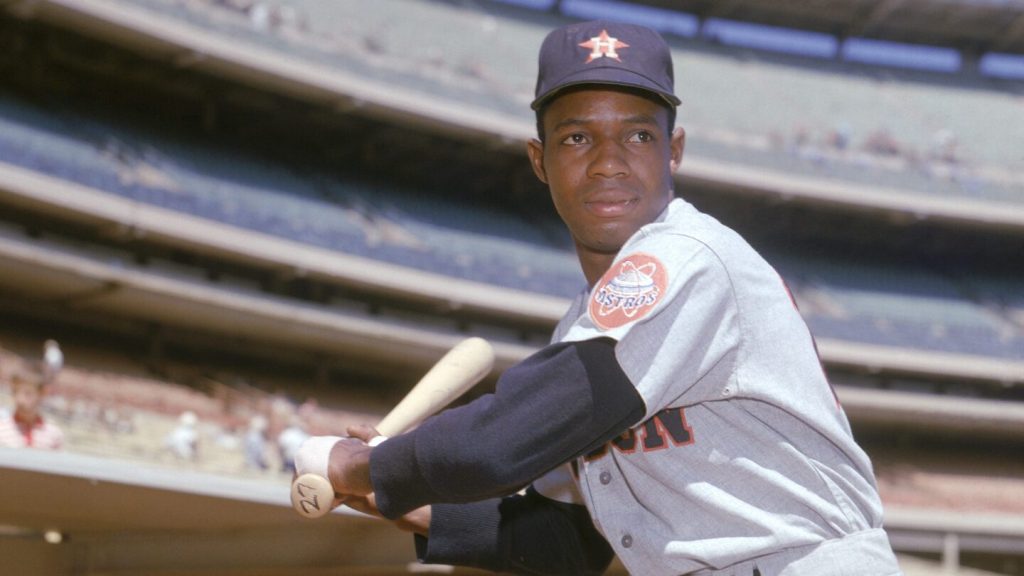
Jimmy Wynn, often overshadowed by other greats of his era, was one of baseball’s most talented and exciting players. Known for his tremendous power, speed, and defensive prowess, Wynn’s career is a study in underappreciation and resilience. Despite playing in an era dominated by larger-than-life stars, Wynn’s contributions to the game are undeniable.
James Howard Wynn was born on January 12, 1942, in Hamilton, Ohio. Growing up in a family that appreciated sports, Wynn developed a love for baseball at an early age. As a young boy, he was fascinated by the game, and his skills on the field were apparent from the outset. Wynn attended Cincinnati’s Taft High School, where he was a standout athlete in baseball and basketball. His athleticism, combined with an innate understanding of the game, set him apart from his peers.
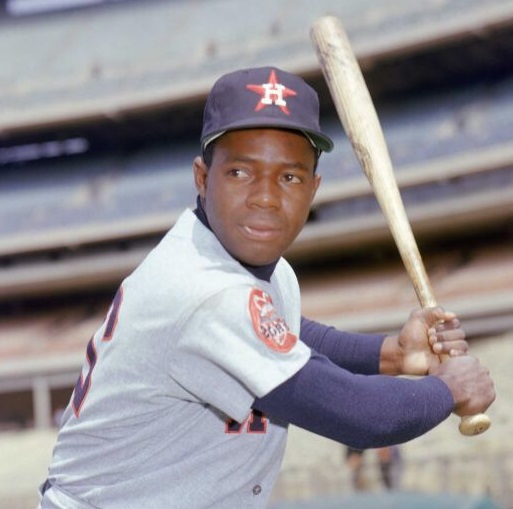
After high school, Wynn attended the University of Southern California (USC), where he further honed his baseball skills. At USC, he played under the tutelage of legendary coach Rod Dedeaux, who would later guide many USC players to major league success. Wynn’s college career was marked by impressive performances, and he quickly gained recognition for his powerful bat and raw talent. His time at USC caught the attention of major league scouts, and he was soon drafted by the Milwaukee Braves in the 15th round of the 1961 MLB Draft.
Wynn’s journey into the majors would not be a smooth one. In his early years in the minors, he struggled to find consistency and refine his swing. However, he never lost his determination or his belief in his abilities. After spending several years developing his skills in the Braves’ minor league system, Wynn was traded to the Houston Colt .45s (later renamed the Houston Astros) in 1963, a move that would shape the rest of his career.
Wynn made his major league debut with the Houston Colts in 1963. At just 21 years old, he was given the chance to play regularly, and he did not disappoint. In his first full season, Wynn batted .262 with 22 home runs and 61 RBIs, establishing himself as one of the team’s primary offensive weapons. His combination of power and speed was evident, as he also stole 13 bases. Though the Astros were not a competitive team during Wynn’s early years, his individual performance stood out.
Wynn’s most notable asset as a player was his ability to hit for power despite standing just 5-foot-9 and weighing around 170 pounds. Known for his quick wrists and impressive bat speed, Wynn could hit the ball with authority. His ability to drive the ball out of the park was a rarity for a player of his size, and he earned the nickname “The Toy Cannon” because of his impressive bat.

In 1966, Wynn had one of his best seasons. He posted career highs in batting average (.276), home runs (27), and RBIs (93). His ability to consistently produce at the plate made him one of the brightest young stars in the National League. As the 1960s came to a close, Wynn’s reputation as a powerful hitter continued to grow, and he was quickly becoming one of the key players for the Astros.
By the late 1960s, Jimmy Wynn was firmly established as one of the top hitters in the National League. His peak years came between 1967 and 1972, a period during which he led the Astros in nearly every offensive category. Wynn’s power was his greatest asset, and he became one of the league’s premier sluggers. In 1967, Wynn hit 37 home runs, finishing in the top 10 in the National League. His performance was instrumental in the Astros’ offensive attack, and he was named an All-Star for the first time in 1969.
During this period, Wynn consistently put up impressive numbers, finishing with double-digit home runs every year. He was also known for his exceptional patience at the plate, as evidenced by his high on-base percentages. Wynn’s keen eye and discipline made him a valuable asset at the top of the Astros’ lineup. Between 1967 and 1972, Wynn posted five seasons with at least 20 home runs, and his ability to hit for both power and average made him a unique offensive force.
One of the defining moments of Wynn’s career came in 1969 when he had his most dominant season at the plate. That year, he hit .269 with 33 home runs, 98 RBIs, and a .379 on-base percentage. His ability to get on base and drive in runs made him one of the most complete players in the game. Despite playing in a stadium known for being tough on hitters, the Astrodome, Wynn still found ways to put up excellent numbers.

In 1972, Wynn posted another stellar season, hitting 27 home runs and driving in 94 runs. Despite playing for a team that struggled to contend, Wynn’s individual accomplishments did not go unnoticed. His success during this time made him one of the top outfielders in the game.
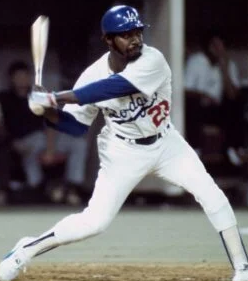
In 1973, Wynn was traded to the Los Angeles Dodgers in a move that would change the course of his career. The trade reunited him with former Astros’ manager, Walt Alston, and placed him on a more competitive team. The Dodgers, who had been a perennial contender in the National League, were looking to add a powerful bat to their lineup, and Wynn fit that need perfectly.
In his first season with the Dodgers, Wynn provided immediate value, hitting .211 with 9 home runs in just 59 games. However, his performance in Los Angeles was not as consistent as it had been in Houston. Injuries and aging were beginning to take their toll on Wynn’s body, and his playing time began to decrease. Despite his reduced role, Wynn was still capable of providing power off the bench and was a key member of the Dodgers’ team. He contributed to the team’s success during the 1974 season, which culminated in the Dodgers making a run to the National League Championship Series.
In 1975, Wynn was released by the Dodgers and signed with the Atlanta Braves. However, his time with the Braves was brief, and he retired from baseball after a season. His final statistics were a testament to his career’s sustained excellence, but they also underscored the disappointment of never having played for a championship team.
Over his 15-year career, Jimmy Wynn accumulated 291 home runs, 1,142 RBIs, and a .250 batting average. Though his batting average was not exceptional, his ability to hit for power and get on base was evident in his .366 on-base percentage. Wynn’s 291 home runs rank among the top 100 in major league history, and his 1,142 RBIs place him in the same elite company. Wynn also hit over 20 home runs in eight seasons, solidifying his reputation as one of the most consistent power hitters of his era.
Though Wynn’s achievements were impressive, he never received the recognition he deserved. Despite his productive career, he was never named to an All-Star team after 1969, and he was often overlooked in the discussion of the game’s greats. His career is a reminder that many players who produce outstanding numbers and have long-lasting careers may not receive the accolades they deserve in terms of recognition, especially when they play for teams that struggle to contend.
Jimmy Wynn’s impact on baseball extends beyond his statistics. He was a player who brought excitement to the game with his combination of power and speed. His ability to hit home runs with such a compact frame was a rarity, and it was a testament to his strength, technique, and raw athleticism. Wynn was a trailblazer for smaller players who were capable of hitting for both power and average, and his career serves as an example of how determination and hard work can lead to success at the highest levels of the sport.
In terms of his legacy, Wynn is remembered as one of the most underrated players in baseball history. Despite playing in an era that included some of the most legendary figures in the game, such as Hank Aaron, Willie Mays, and Roberto Clemente, Wynn still managed to carve out a place for himself as one of the best offensive players of the 1960s and 1970s. While his career was cut short and his later years in the league were less productive, Wynn’s early seasons, particularly with the Houston Astros, stand as one of the most impressive stretches of offensive production during that era.
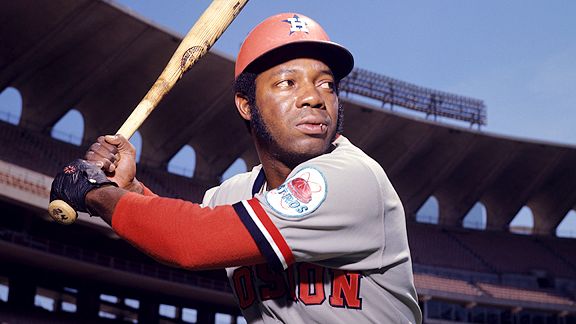
Wynn’s nickname, “The Toy Cannon,” was an apt reflection of his abilities on the field. Though he was smaller than many of his contemporaries, he had a powerful bat that belied his size. The nickname was a tribute to his dynamic presence at the plate and his ability to hit home runs with ease.
Despite never reaching the postseason with his teams, Jimmy Wynn’s contributions to baseball cannot be overlooked. His power, speed, and defense made him a valuable player for the teams he played for, and his impact on the game remains significant. Although his career achievements may not have garnered the same attention as other stars of his era, Wynn’s place in baseball history is firmly secured. His legacy is a reminder that greatness in baseball is not always measured by championships and accolades but by the consistency, determination, and skill that a player brings to the game every day.


 The Baseball Scholar
Leave a comment