
Rafael Palmeiro’s MLB career is a fascinating and complex story of success, controversy, and lasting impact. Over two decades, Palmeiro established himself as one of the most consistent and productive hitters of his era. A member of the exclusive 3,000-hit and 500-home-run clubs, he built a statistical resume that rivals the game’s all-time greats. Yet his career is often remembered not only for his offensive achievements but also for the controversy surrounding performance-enhancing drugs. Palmeiro’s journey, from his early life and development to his playing years and the enduring legacy of his career, offers a nuanced portrait of a player whose accomplishments on the field remain remarkable despite the shadow cast by his later years.
Rafael Palmeiro was born on September 24, 1964, in Havana, Cuba. His family emigrated to the United States when he was a child, seeking opportunities and stability in Miami, Florida. Growing up in a baseball-loving household, Palmeiro was exposed to the sport at an early age. He displayed an innate talent for hitting, quickly distinguishing himself among his peers.
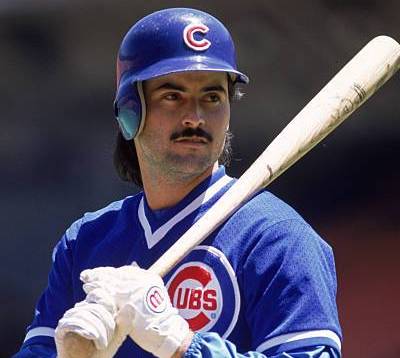
Palmeiro attended Miami Jackson High School, where his combination of natural talent and work ethic made him a standout on the baseball team. His fluid left-handed swing, which would later become his hallmark, was already evident in his teenage years. Recognizing his potential, scouts and college recruiters paid close attention to the budding star.
After graduating from high school, Palmeiro accepted a scholarship to Mississippi State University, where he became one of the most feared hitters in college baseball. Playing alongside future major leaguers like Will Clark, Palmeiro helped lead the Bulldogs to the College World Series and cemented his reputation as an elite prospect. In 1985, after a standout collegiate career, Palmeiro was selected in the first round of the MLB Draft by the Chicago Cubs, setting the stage for his professional journey.
Palmeiro made his major league debut with the Chicago Cubs on September 8, 1986. Initially used as a corner outfielder, he quickly showcased his ability to hit for average and get on base. In his first full season in 1987, Palmeiro batted .247 with 14 home runs and 55 RBIs, showing flashes of the offensive prowess that would later define his career.
Despite his promising start, Palmeiro struggled to find a permanent role with the Cubs, as the team experimented with him in various positions. The crowded roster, combined with management’s focus on other young players, limited Palmeiro’s opportunities to establish himself as a cornerstone of the team. This uncertainty led to a pivotal trade in December 1988, when Palmeiro was sent to the Texas Rangers as part of a multi-player deal.
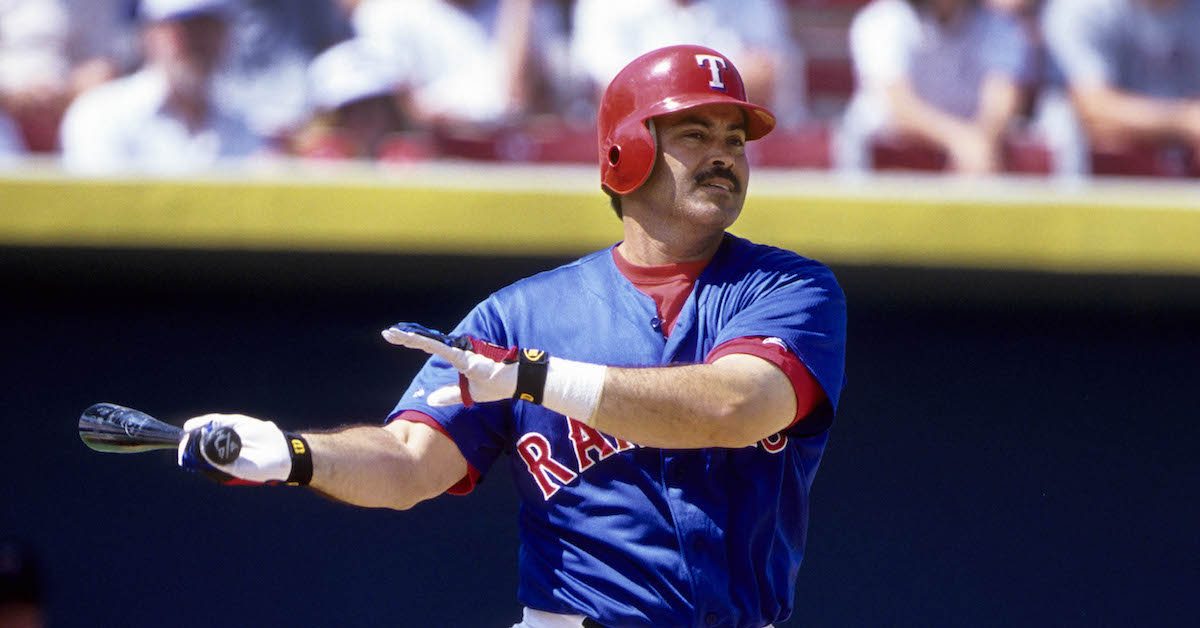
The trade to the Texas Rangers proved to be a turning point in Palmeiro’s career. Freed from the constraints of his role in Chicago, he quickly developed into one of the most consistent hitters in the American League. In his first season with the Rangers in 1989, Palmeiro batted an impressive .275 with eight home runs and 64 RBIs, demonstrating his ability to hit for both average and power.
By 1990, Palmeiro had firmly established himself as a key player in the Rangers’ lineup. That year, he batted .319, finishing second in the American League batting race and earning his first All-Star selection. Palmeiro’s smooth swing, coupled with his ability to drive the ball to all fields, made him a perennial threat at the plate. Over the next several seasons, he continued to put up stellar numbers, becoming one of the most reliable and productive hitters in baseball.
During his first stint with the Rangers, Palmeiro developed into more than just an offensive force. He worked diligently to improve his defense at first base, earning a reputation as a capable fielder. His dedication paid off in 1997 when he won his first Gold Glove Award, further solidifying his value as a complete player.
After the 1993 season, Palmeiro signed as a free agent with the Baltimore Orioles, beginning the next chapter of his career. Playing in Camden Yards, one of the most hitter-friendly ballparks in baseball, Palmeiro thrived offensively. In his first season with the Orioles, he hit .319 with 23 home runs and 76 RBIs, continuing to establish himself as one of the premier hitters in the league.
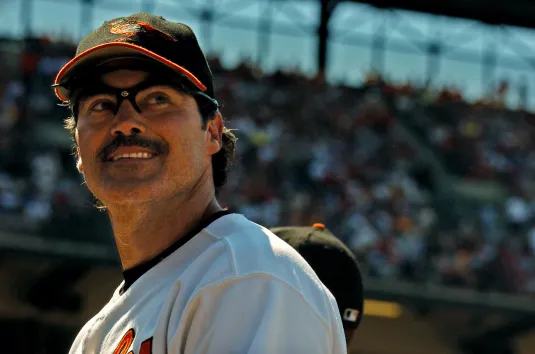
Palmeiro’s power numbers reached new heights during his time in Baltimore. In 1995, he hit 39 home runs and drove in 104 runs, marking the first of nine consecutive seasons with at least 38 home runs and 100 RBIs. His consistency and ability to deliver in clutch situations made him a fan favorite and a leader in the Orioles’ clubhouse.
One of Palmeiro’s most memorable moments with the Orioles came in the 1996 American League Division Series against the Cleveland Indians. He hit a crucial home run in Game 1, helping propel Baltimore to an upset victory over the heavily favored Indians. Although the Orioles ultimately fell short in the postseason, Palmeiro’s performance showcased his ability to excel on the game’s biggest stage.
In 1999, Palmeiro returned to the Texas Rangers as a free agent, rejoining the team where he had first blossomed into a star. Despite being in his mid-30s, Palmeiro showed no signs of slowing down. He continued to put up extraordinary numbers, hitting 47 home runs in 1999 and finishing the season with a career-high 148 RBIs. His power-hitting prowess made him a central figure in the Rangers’ potent lineup, which also featured stars like Ivan Rodriguez and Juan Gonzalez.
Palmeiro’s remarkable consistency during this period was exemplified by his ability to maintain elite production year after year. From 1999 to 2003, he averaged 41 home runs and 121 RBIs per season, earning multiple Silver Slugger Awards and further cementing his legacy as one of the greatest hitters of his generation.

In 2004, Palmeiro returned to the Baltimore Orioles for a second stint with the team. By this point in his career, he was on the cusp of reaching two of baseball’s most prestigious milestones: 500 home runs and 3,000 hits. Palmeiro achieved the first milestone on May 11, 2003, when he hit his 500th career home run, joining an elite group of sluggers. Two years later, on July 15, 2005, he recorded his 3,000th hit, becoming one of only a handful of players in MLB history to achieve both feats.
Despite these remarkable achievements, Palmeiro’s career was overshadowed by controversy in 2005 when he was suspended for violating Major League Baseball’s policy on performance-enhancing drugs. The suspension, which came just months after Palmeiro had testified before Congress denying the use of steroids, cast a cloud over his accomplishments and tarnished his reputation.
Rafael Palmeiro retired with a career batting average of .288, 3,020 hits, 569 home runs, and 1,835 RBIs. He ranks among the top 20 all-time in both home runs and RBIs, and his 3,020 hits place him in elite company. A four-time All-Star, three-time Gold Glove winner, and two-time Silver Slugger recipient, Palmeiro’s statistical achievements rank him among the most productive hitters in MLB history.
Palmeiro’s legacy is one of immense accomplishment and lingering controversy. On the field, he was a model of consistency, delivering elite production year after year. His ability to combine power and average made him one of the most feared hitters of his era, and his longevity allowed him to compile numbers that rival the greatest players in baseball history.

However, the allegations of steroid use have complicated Palmeiro’s place in the game’s history. Despite his impressive statistics, he has not been elected to the Baseball Hall of Fame, as voters continue to grapple with the impact of performance-enhancing drugs on the sport.
Beyond the controversy, Palmeiro’s career serves as a reminder of both the heights of individual achievement and the challenges of maintaining integrity in a sport deeply affected by scandal. His story is a testament to the complexities of greatness and the enduring impact of one player’s journey through the game of baseball.


 The Baseball Scholar
Leave a comment