
Jim Edmonds, known for his unparalleled defensive prowess in center field and consistent offensive production, is celebrated as one of the finest all-around players in Major League Baseball (MLB) history. His career, spanning from the mid-1990s through the late 2000s, is marked by breathtaking catches, a power-packed bat, and an innate ability to change the course of games with his athleticism and intelligence. A figure who captured the hearts of fans with his flair for the dramatic, Edmonds left an indelible mark on the sport of baseball. His journey from a promising prospect to a celebrated MLB star is a testament to his determination, skill, and passion for the game.
James Patrick Edmonds was born on June 27, 1970, in Fullerton, California. Raised in Southern California, Edmonds grew up in an environment that encouraged athletic pursuits. Baseball quickly became his sport of choice, and from a young age, he displayed a natural aptitude for the game. His combination of athletic ability and baseball intelligence was apparent even in his youth, as he excelled both in Little League and at Diamond Bar High School.

Edmonds’ high school career was marked by standout performances, particularly as a hitter. While his defensive skills would later become his calling card, it was his powerful swing and keen eye at the plate that initially attracted the attention of scouts. However, Edmonds was not a highly-touted prospect when he graduated from high school. He was selected in the seventh round of the 1988 MLB Draft by the California Angels, a position that reflected his raw talent but also suggested doubts about his long-term potential.
Edmonds began his professional career in the Angels’ minor league system, where he worked diligently to refine his skills. Although he was primarily a corner outfielder early on, his coaches quickly recognized his potential to excel in center field. With a combination of speed, a strong throwing arm, and a natural instinct for tracking fly balls, Edmonds emerged as a defensive standout.
Offensively, Edmonds showcased promise, but he required time to adjust to professional pitching. His progression through the minor leagues was steady rather than meteoric. By the early 1990s, he had developed into a well-rounded player capable of contributing in multiple facets of the game. His minor league performance earned him a call-up to the majors, and in 1993, Edmonds made his MLB debut with the California Angels.
Edmonds’ rookie campaign was relatively uneventful, as he struggled to find consistent playing time and establish himself as an everyday player. However, by 1994, he had earned a regular role in the Angels’ lineup, and his talent began to shine. Over the next few seasons, Edmonds blossomed into one of the league’s premier outfielders. His offensive output improved steadily, and his defense in center field drew widespread acclaim.

The 1995 season marked a turning point in Edmonds’ career. He hit .290 with 33 home runs and 107 RBIs, establishing himself as a legitimate power hitter. His ability to drive the ball to all fields, coupled with his plate discipline, made him a formidable presence in the Angels’ lineup. That same year, Edmonds began to gain national recognition for his defensive exploits. His diving catches and leaping grabs over the wall became regular features on highlight reels, earning him the nickname “Jimmy Baseball.”
In March 2000, Edmonds was traded to the St. Louis Cardinals, a move that would define the prime of his career. The trade, which sent pitcher Kent Bottenfield and infielder Adam Kennedy to the Angels, proved to be a coup for the Cardinals. Edmonds flourished in St. Louis, becoming a cornerstone of the franchise and one of the most beloved players in Cardinals history.
Edmonds’ first season with the Cardinals was nothing short of spectacular. He batted .295 with 42 home runs and 108 RBIs, earning his first Gold Glove Award and an All-Star selection. His defensive brilliance in center field became the stuff of legend, with one catch in particular—a fully extended, over-the-shoulder grab against the Cincinnati Reds—cementing his reputation as one of the greatest defensive players of all time.
Over the next seven seasons, Edmonds continued to excel for the Cardinals, combining power and precision at the plate with breathtaking plays in the outfield. He won six consecutive Gold Glove Awards from 2000 to 2005, showcasing a rare combination of athleticism and instinct. His ability to read balls off the bat and take precise routes to the ball set him apart from his peers.
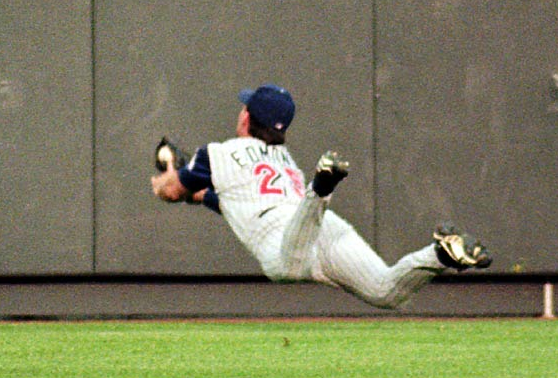
Offensively, Edmonds remained a consistent force. He surpassed 30 home runs in five seasons with the Cardinals and drove in over 100 runs on multiple occasions. In 2004, he posted one of his finest seasons, hitting .301 with 42 home runs, 111 RBIs, and a career-high .643 slugging percentage. That year, Edmonds played a pivotal role in leading the Cardinals to the National League pennant. His walk-off home run in Game 6 of the NLCS against the Houston Astros remains one of the most iconic moments in Cardinals history.
Edmonds’ contributions to the Cardinals extended beyond individual accolades. He was a key figure in the team’s sustained success during the early 2000s, helping the Cardinals reach the playoffs in six of his eight seasons with the club. The pinnacle of Edmonds’ career came in 2006 when he helped the Cardinals capture their first World Series title in 24 years. Although injuries limited his production that season, Edmonds’ leadership and experience were invaluable during the team’s postseason run.
After the 2007 season, Edmonds was traded to the San Diego Padres. While his time in San Diego was short-lived, he found new life with the Chicago Cubs later in the 2008 season. Edmonds provided a veteran presence and contributed key hits during the Cubs’ playoff push, batting .256 with 19 home runs in 85 games. He retired briefly after the 2008 season but made a brief comeback with the Milwaukee Brewers and Cincinnati Reds in 2010.
Jim Edmonds retired with a .284 career batting average, 393 home runs, 1,199 RBIs, and 1,251 runs scored. His defensive statistics are equally impressive, with a career fielding percentage of .988 and countless memorable plays that do not appear on paper. Edmonds earned eight Gold Glove Awards, four All-Star selections, and a Silver Slugger Award. His blend of offensive power and defensive brilliance made him one of the most well-rounded players of his generation.

Edmonds’ impact on baseball extends beyond his impressive statistics. He redefined the standard for defensive excellence in center field, inspiring a generation of players to prioritize defense as much as offense. His acrobatic catches and fearless approach to the game set a new benchmark for outfield play and elevated the importance of defense in a sport often dominated by offensive highlights.
As a member of the Cardinals, Edmonds also became a fan favorite for his charisma, work ethic, and clutch performances. He embodied the spirit of the franchise and helped restore its status as one of baseball’s premier teams. His contributions to the Cardinals’ 2006 World Series championship are particularly significant, as they ended a decades-long drought and solidified Edmonds’ legacy as a champion.
Jim Edmonds’ legacy is one of grace, power, and determination. He was a player who thrived on the biggest stages and delivered in the most crucial moments. His highlight-reel plays continue to be celebrated, and his influence on the game remains evident in the emphasis placed on outfield defense in today’s game.

Off the field, Edmonds has remained active in baseball and broadcasting, sharing his insights and passion for the game. His unique combination of skills, work ethic, and love for the sport has left an enduring mark on baseball and its fans.
In conclusion, Jim Edmonds’ career is a testament to the power of talent, perseverance, and dedication. His achievements on the field, coupled with his impact on the game’s culture and values, ensure that he will be remembered as one of the most dynamic and influential players in MLB history.



 The Baseball Scholar
Leave a comment