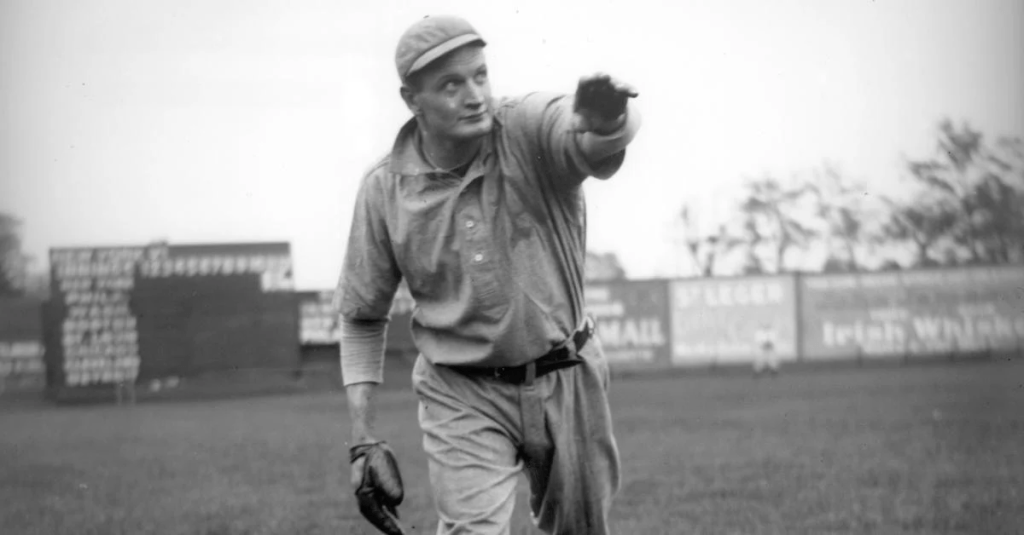
Rube Waddell, one of the most colorful and enigmatic figures in baseball history, was a dominant pitcher during the early years of Major League Baseball. Known for his eccentric personality and overpowering fastball, Waddell left an indelible mark on the game. He was not only a tremendous talent on the mound but also a figure of intrigue due to his unpredictable behavior and larger-than-life persona. His MLB career, spanning from 1897 to 1910, featured remarkable statistical achievements and numerous anecdotes that have become part of baseball folklore.
George Edward Waddell, later nicknamed “Rube,” was born on October 13, 1876, in Bradford, Pennsylvania. Growing up in a rural setting, Waddell displayed an early interest in sports, particularly baseball. His natural athleticism and strong throwing arm became evident during his childhood, as he would often throw rocks with remarkable accuracy and power. Waddell’s upbringing in a small town shaped his free-spirited personality, which would later define his reputation as one of baseball’s most eccentric characters.

Waddell’s early exposure to baseball came through local teams, where he quickly gained attention for his extraordinary pitching ability. However, his formal education and structured development as a player were limited due to his restless nature and short attention span. Despite these challenges, Waddell’s raw talent on the mound was undeniable, and he soon attracted the attention of semi-professional and professional teams.
Waddell’s professional baseball career began in 1897 when he joined the Louisville Colonels of the National League. His debut season was brief, as he pitched in just two games, but it was clear that he possessed immense potential. His erratic behavior and inability to focus, however, led to difficulties with team management and limited his opportunities.
After bouncing around various minor league teams and semi-professional clubs, Waddell found a more stable opportunity with the Pittsburgh Pirates in 1900. During his time with the Pirates, Waddell began to showcase the dominant fastball and sharp curveball that would become his signature pitches. Despite his success on the field, his off-field antics, which included disappearing from the team to go fishing or chasing fire trucks, made him a challenging player to manage.
Dominance with the Philadelphia Athletics
Waddell’s career reached its zenith after he joined the Philadelphia Athletics in 1902 under the leadership of Connie Mack, one of baseball’s most respected managers. Mack’s patient and understanding approach helped harness Waddell’s talent, even if it could not completely rein in his eccentric behavior. With the Athletics, Waddell established himself as one of the premier pitchers of his era.

During the 1902 season, Waddell compiled a record of 24-7 with a league-leading 2.05 ERA and 210 strikeouts. His ability to overpower hitters was unmatched, and he quickly became a fan favorite for his theatrical style of play. Waddell’s 1903 season was even more impressive, as he posted a 21-16 record with a 3.23 ERA and led the league with 302 strikeouts, a remarkable feat during an era when pitching dominated the game and strikeouts were less common.
Waddell’s best season came in 1904, a year that cemented his place in baseball history. He finished with a 25-19 record, a 1.62 ERA, and an astounding 349 strikeouts. His strikeout total set a single-season record that would stand for decades, underscoring his dominance on the mound. Waddell’s ability to command his fastball and mix in a devastating curveball made him virtually unhittable on many occasions. He led the league in strikeouts for six consecutive seasons from 1902 to 1907, a testament to his sustained excellence.
Rube Waddell was as famous for his off-field antics as he was for his pitching prowess. His behavior was often described as childlike, and he was known for his short attention span and impulsive actions. Stories of Waddell leaving games to chase fire trucks, wrestling alligators, or engaging in impromptu performances for fans became the stuff of legend. He was also known to disappear for days at a time, often to pursue fishing or other recreational activities.
One of the most famous anecdotes about Waddell involved his fascination with shiny objects and animals. Opposing teams would sometimes try to distract him by waving shiny objects or releasing puppies near the field, knowing that Waddell’s attention would be diverted. Despite these distractions, Waddell’s immense talent often allowed him to prevail, further adding to his mystique.

Waddell’s relationships with teammates and managers were equally colorful. While some found his antics frustrating, others were charmed by his playful nature. Connie Mack, in particular, demonstrated great patience with Waddell, recognizing that his eccentricity was inseparable from his brilliance on the mound. Mack’s ability to manage Waddell effectively contributed to the pitcher’s success with the Athletics.
As Waddell entered his thirties, his effectiveness on the mound began to wane. His lifestyle, which included heavy drinking and a lack of discipline, took a toll on his physical health and performance. After leaving the Athletics in 1907, Waddell spent time with the St. Louis Browns, where he continued to show flashes of brilliance but struggled to maintain consistency.
Waddell’s major league career came to an end in 1910, but he continued to pitch in minor league and semi-professional baseball for several years. Despite his declining skills, he remained a popular figure due to his charisma and entertaining personality.
Rube Waddell’s career statistics reflect his dominance during the prime of his career. Over 13 seasons in the major leagues, he compiled a record of 193-143 with a 2.16 ERA and 2,316 strikeouts. His strikeout totals were particularly remarkable for the Deadball Era, when hitters prioritized contact and strikeouts were relatively rare. Waddell led the league in strikeouts six times and remains one of the all-time leaders in strikeouts per nine innings.

In addition to his individual achievements, Waddell played a key role in the success of the Philadelphia Athletics during his tenure with the team. He was inducted into the Baseball Hall of Fame in 1946, a recognition of his extraordinary talent and contributions to the game.
Rube Waddell’s impact on baseball extends beyond his impressive statistics and achievements. He was one of the first true characters of the game, embodying the spirit of a bygone era when players were larger-than-life figures both on and off the field. Waddell’s unique personality and style of play helped popularize baseball and drew fans to the ballpark, making him one of the sport’s early stars.
As a pitcher, Waddell set a standard for strikeout dominance that influenced future generations of players. His ability to overpower hitters and rack up strikeouts was unprecedented for his time, and his single-season strikeout record stood as a benchmark of excellence for decades.
Waddell’s life also serves as a cautionary tale about the challenges of managing talent and the importance of discipline and focus. While his eccentricity endeared him to fans, it also limited his career longevity and prevented him from reaching even greater heights. Nevertheless, his contributions to the game remain significant, and his story continues to captivate baseball enthusiasts.

Rube Waddell’s MLB career was a remarkable blend of extraordinary talent, unforgettable moments, and unparalleled eccentricity. As one of the most dominant pitchers of the Deadball Era, Waddell left an enduring legacy as a trailblazer for strikeout pitchers and a beloved figure in baseball history. His combination of on-field brilliance and off-field antics made him a true original, and his impact on the game is still felt more than a century after his playing days. For all his quirks and challenges, Rube Waddell remains one of baseball’s most fascinating and influential characters, a player whose story embodies the rich tapestry of the sport’s early years.



 The Baseball Scholar
Leave a comment