
George Herman “Babe” Ruth Jr., born on February 6, 1895, in Baltimore, Maryland, is one of the most iconic and transformative figures in the history of sports. Known for his prodigious talent and larger-than-life personality, Ruth revolutionized baseball during his career, elevating the sport’s popularity and forever changing its landscape. His life story, from humble beginnings to global superstardom, is a tale of triumph, reinvention, and enduring legacy.
Babe Ruth grew up in a modest home in Baltimore, one of eight children born to George Herman Ruth Sr. and Katherine Schamberger. The Ruth household faced significant challenges, and only two of the children survived past infancy. Ruth’s mischievous behavior and lack of structure led his parents to send him to St. Mary’s Industrial School for Boys, a reformatory and orphanage, at the age of seven. At St. Mary’s, Ruth’s life took a pivotal turn under the guidance of Brother Matthias, a disciplinarian and talented baseball player who recognized Ruth’s potential. Brother Matthias taught Ruth the fundamentals of baseball, and the young boy quickly developed into a standout player, particularly as a left-handed pitcher.
By his teenage years, Ruth’s talent had drawn the attention of professional scouts. In 1914, Jack Dunn, owner of the minor league Baltimore Orioles, signed him to his first professional contract. Ruth’s teammates nicknamed him “Dunn’s Babe,” a moniker that would stick and eventually become synonymous with greatness. That same year, the Orioles sold Ruth’s contract to the Boston Red Sox, marking the beginning of a legendary career.

Ruth debuted in Major League Baseball with the Boston Red Sox in 1914 as a left-handed pitcher. He quickly established himself as one of the league’s premier pitchers, combining a powerful fastball with remarkable control. In 1916, Ruth posted a 23-12 record and led the American League with a 1.75 ERA. He also showcased his postseason prowess, throwing 14 shutout innings in a single game during the 1916 World Series, a record that still stands.
While Ruth’s pitching was exceptional, his batting prowess began to attract attention. By 1918, he was being used more frequently as a hitter, and his powerful swing captivated fans. In 1919, Ruth hit 29 home runs, setting a single-season record and signaling a shift in baseball from the low-scoring “dead-ball era” to the high-scoring “live-ball era.” However, financial difficulties led the Red Sox to sell Ruth’s contract to the New York Yankees in 1919, a transaction often referred to as the “Curse of the Bambino” due to the Red Sox’ subsequent championship drought.
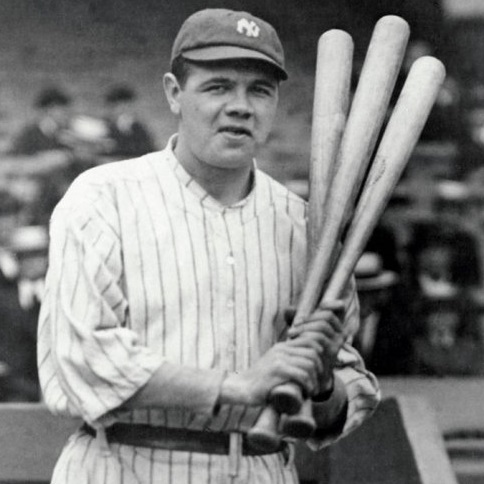
Ruth’s move to the Yankees marked the beginning of an era of dominance, both for him and the team. In his first season with New York in 1920, Ruth hit an astonishing 54 home runs, more than any other team in the league. He followed that up with 59 home runs in 1921 and a then-record 60 home runs in 1927. Ruth’s offensive production transformed the Yankees into perennial contenders and helped usher in the construction of Yankee Stadium, often called “The House That Ruth Built.”
During his tenure with the Yankees, Ruth led the team to seven American League pennants and four World Series titles, cementing their reputation as baseball’s premier franchise. Ruth’s hitting statistics were unparalleled: he finished his career with a .342 batting average, 714 home runs, and 2,214 RBIs. His ability to consistently deliver in clutch moments made him a fan favorite and a nightmare for opposing pitchers.
Ruth’s larger-than-life personality only added to his allure. Known for his love of food, drink, and nightlife, he became a cultural icon who transcended the sport. Despite his indulgences, Ruth’s work ethic on the field and his charitable efforts off it endeared him to millions. He was one of the first athletes to achieve true celebrity status, appearing in films, advertisements, and public events that made him a household name.
As Ruth entered his late 30s, the physical toll of his lifestyle began to affect his performance. While he remained a productive hitter, his overall numbers declined, and his role on the Yankees diminished. In 1934, Ruth played his final season with the team before joining the Boston Braves in 1935 in hopes of transitioning into a managerial role. However, his time with the Braves was short-lived, and Ruth retired later that year. He left the game with numerous records, including his iconic 714 career home runs, a mark that stood until 1974.
After retiring, Ruth remained an influential figure in baseball, though he struggled to find a post-playing role that suited him. His health began to decline in the 1940s, and he was diagnosed with throat cancer in 1946. Despite his illness, Ruth continued to make public appearances, including a memorable visit to Yankee Stadium in 1948 for its 25th anniversary. He passed away on August 16, 1948, at the age of 53.
Beyond his on-field achievements, Babe Ruth’s influence on baseball and American culture was transformative. Before Ruth, baseball’s “dead-ball era” was characterized by small-ball strategies like bunting, stealing bases, and hitting for contact. Ruth’s power-hitting style revolutionized the game, ushering in the “live-ball era” and making the home run a central feature of baseball’s appeal. His ability to consistently hit towering home runs captivated fans and redefined what was possible on the diamond.
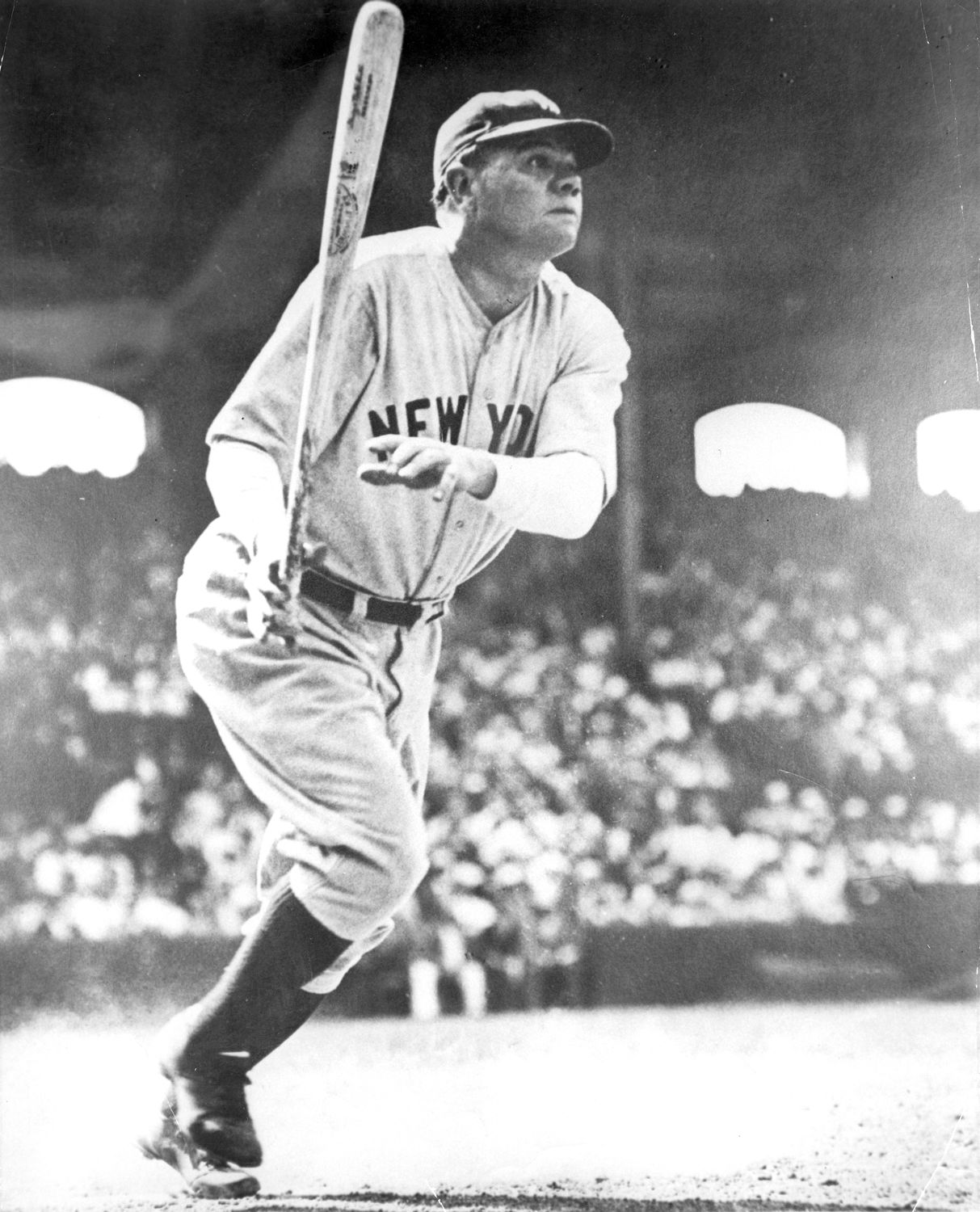
Ruth’s impact on the game’s popularity cannot be overstated. In the 1920s, baseball was recovering from the infamous 1919 Black Sox scandal, which had tarnished the sport’s reputation. Ruth’s electrifying performances and charismatic personality helped restore public trust and enthusiasm for the game. He became a symbol of hope and joy during a tumultuous era, providing escapism and excitement in the years following World War I.
Off the field, Ruth’s larger-than-life persona made him a cultural icon. He was one of the first athletes to achieve celebrity status, appearing in movies, endorsing products, and engaging with fans in ways that were unprecedented at the time. Ruth’s charisma and generosity endeared him to the public, and he often visited hospitals, supported charitable causes, and made efforts to connect with ordinary people. His influence extended far beyond baseball, making him a symbol of the American Dream—a rags-to-riches story that resonated with millions.
Ruth’s legacy endures as a foundational figure in the history of baseball. He was among the inaugural class inducted into the Baseball Hall of Fame in 1936, and his records and impact continue to be celebrated. His career set the standard for greatness, inspiring generations of players and fans alike. Babe Ruth not only elevated the game of baseball but also embedded it deeply into the fabric of American culture, ensuring his place as one of the most influential figures in sports history.



 The Baseball Scholar
Leave a comment